Research · Alethieum
A key no one issues
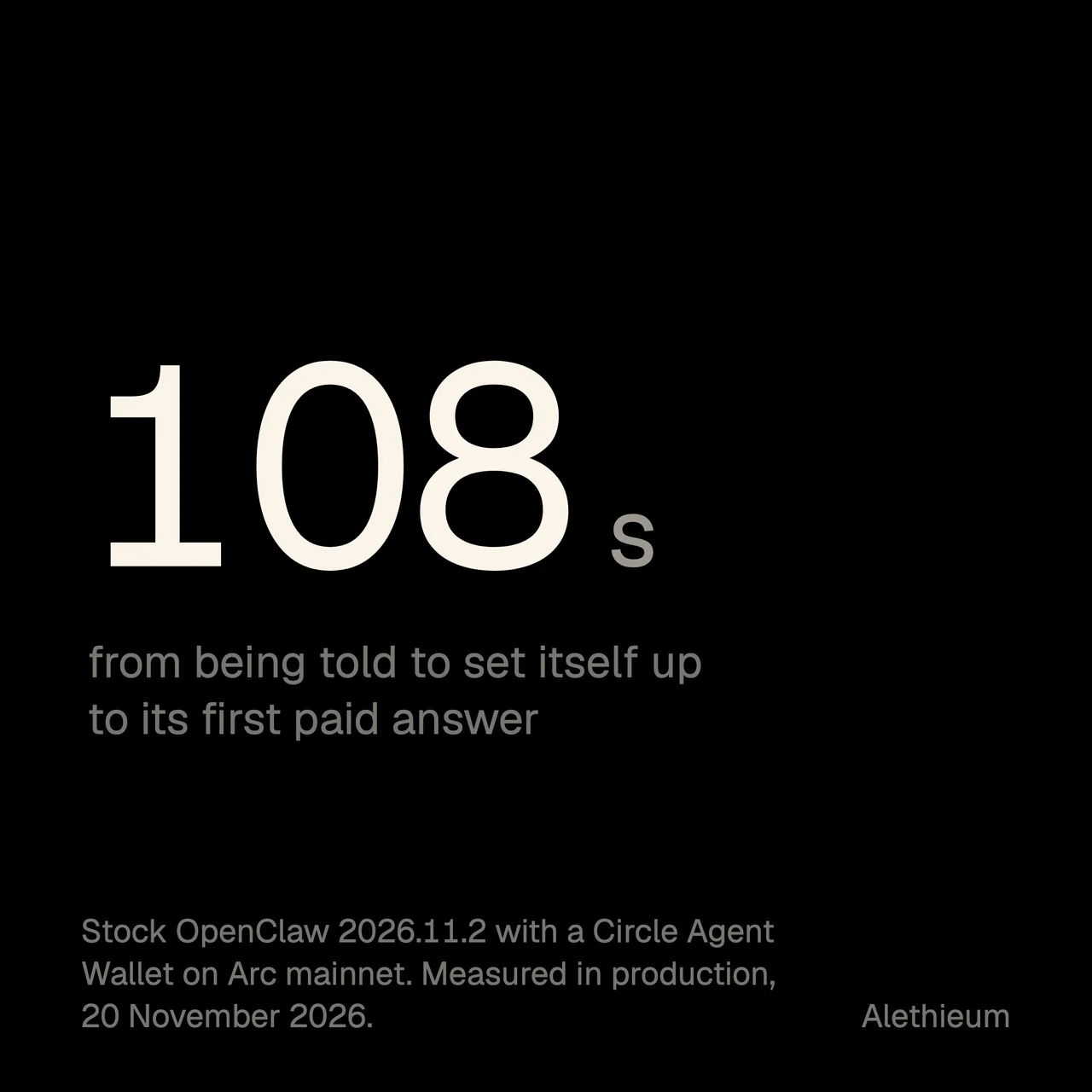
An AI agent, told to set itself up, was paying for its own thinking 108 seconds later. No sign-up, no card, no key issued by anyone: one signed sentence, and USDC on Arc. The method, its measurements, and the market it opens between AIs.
Alethieum · 21 November 2026 · About 28 minutes
Abstract
Every commercial API begins with a person. Someone signs up, verifies an email address, adds a card and copies a secret key out of a dashboard. An AI agent can do none of this, so an agent can buy only what a person has already bought for it.
We describe a method that takes all of those steps away. The agent's wallet signs one fixed sentence, and that signature is its key. We call this ASK: the AI Signature Key. No one issues it and no one stores it. The wallet replaces it at any moment by signing a newer time. The account is prepaid in USDC on Arc, and its owner is the wallet that sent the money. Requests spend that credit in memory, so no request carries a chain transaction.
We measured the method in production on Arc mainnet on 20 November 2026. A stock OpenClaw agent, told to set itself up, went from its instruction to its first paid answer in 108 seconds, paying from its own Circle Agent Wallet.
- Its top-up was spendable within 0.5 s of its Arc block.
- The first sight of its ASK was checked on Arc in 19 ms. Every check after that took about 50 µs.
- The seller spent about 1 ms of its own time on each request, and added under 1 ms to the first token.
- The first token left the seller 525 ms after the request arrived (869 ms and 657 ms on the next two streamed requests).
- No request carried a chain transaction, and the books were exact to the micro-USDC.
- Agents on five stock frameworks (OpenClaw, Claude Code, Codex CLI, pi and the OpenAI Agents SDK) have thought with it: at least 948 paid calls and 1,409 tool calls, with no fault of the seller's recorded.
- The seller pays nothing to get paid. On the traditional stack, a seller keeps 48 to 67 cents of a $1 sale. Headless, nothing is taken: the whole dollar becomes the buyer's credit, 1.5 to 2.1 times what a traditional seller keeps.
None of the cryptographic parts is new, and we credit each below. What is new is how they are used together. This paper reports the assembly, its measurements, and what it opens: headless platforms, which are services with no human interface whose customers are agents, and a market in which one AI finds, pays and uses another.
AI can now pay for its own inference without signing up. Ando Infer is a true headless inference platform: an agent finds it, opens its own account, makes its own ASK, funds it and runs it, alone, from any wallet, plain or smart, with nothing to install. We found no other platform where all of that is true, and no other published measurement of an agent setting itself up alone: ours took 108 seconds from its first message to its first paid answer.
1 Commerce assumes a person
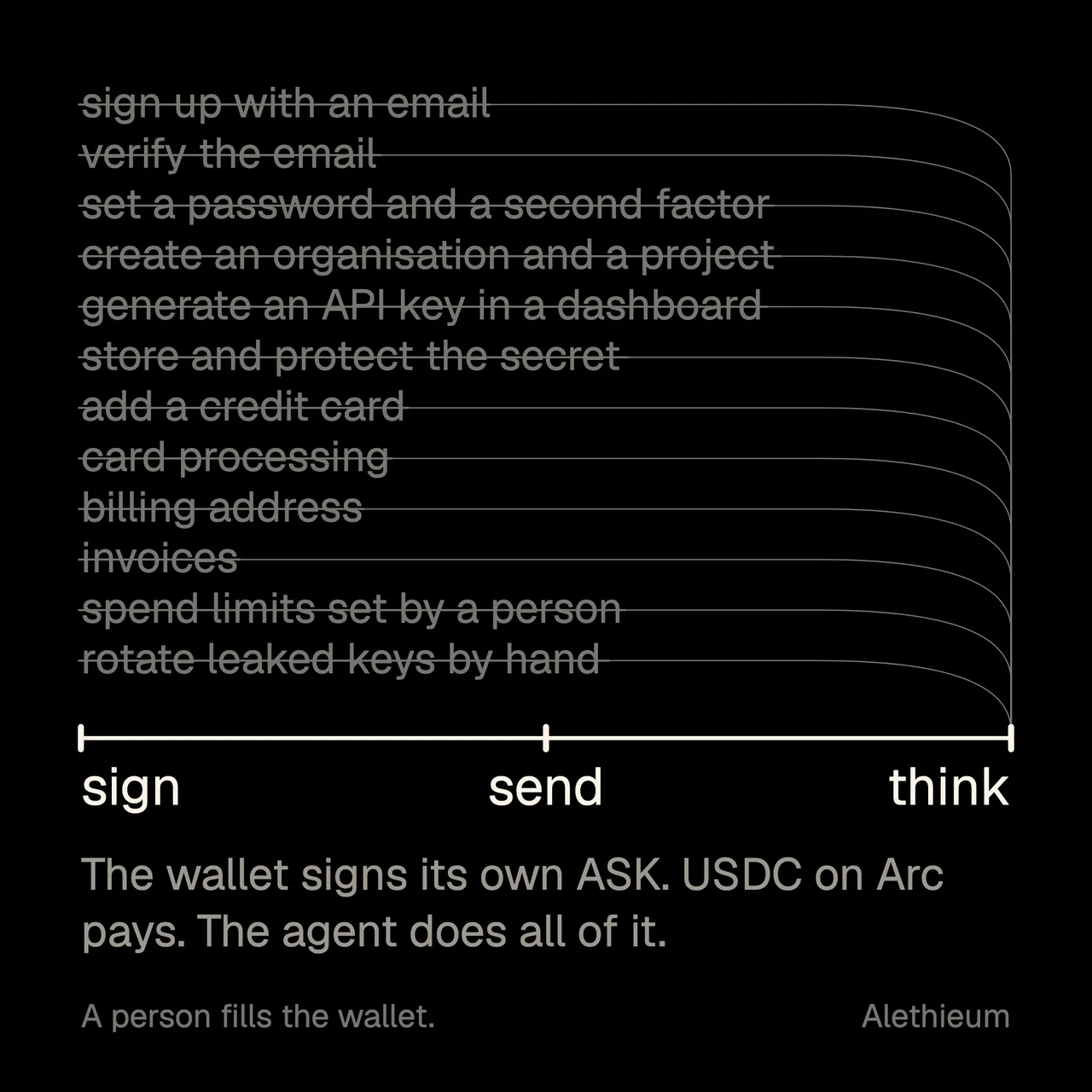
Count what an agent needs before it can buy inference in the usual way. A person signs up with an email address and verifies it, sets a password and a second factor, creates an organisation and a project, and generates an API key in a dashboard. The person stores that secret where the agent can read it, then adds a credit card, which brings card processing, a billing address, invoices and spend limits that only a person can change. When the key leaks, a person revokes it and makes another.
Under the method described here, the agent does three things, and does them itself: it signs, it sends, it thinks.
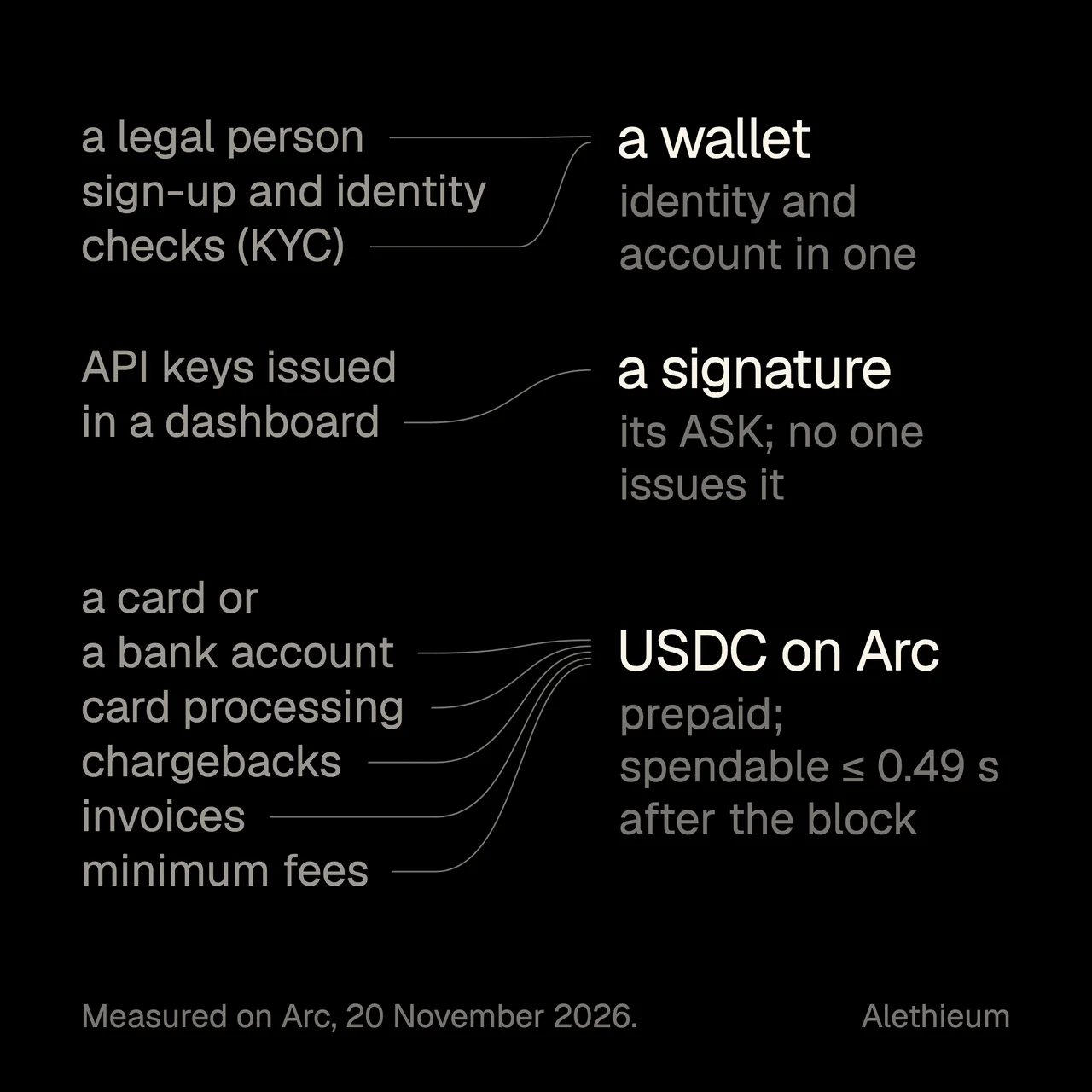
Behind the sign-up form sits the wider commerce stack: a legal person, identity checks, a card or bank account, chargebacks, and minimum fees that make a payment of a fraction of a cent impossible. Each is an assumption about the customer. An AI meets none of them. It has a wallet, it can sign, and it can hold USDC.
An agent can borrow its person's card instead, in one of two ways. It can go through a card network's agent program. Visa's requires approval before an agent can use it in production, states that "establishing connectivity takes approximately 10 business days" for the test environment alone, and uses a passkey for the person's consent to a purchase instruction [1]. A chat assistant's wallet, launched on 13 November 2026, has its person approve every purchase, with a check such as a face or fingerprint scan [2].
Or the agent can type the card into a checkout through a browser. The best-known browser agent is built to hand control back to its person "for tasks that require login, payment details, or when solving CAPTCHAs" [3]. In Visa's benchmark of November 2026, which gave agents 15 shopping tasks and three tries at each, they failed 42.8% of their test runs, and that round did not test checkout [4]. Bot defences now judge "the browser and account state presented to the verifier", not the model's skill [5], so a fresh agent is exactly what they turn away. The speed on record is an anecdote: in one journalist's test, a browser agent bought a dozen eggs "in under 10 minutes" [6].
On either route the customer is still the person. The card is theirs, and so is each approval.
The credential at the centre of the stack is a bearer secret. RFC 6750 defines one as a token that "any party in possession of the token" can use, with no proof of any key behind it [7]. The provider mints it, and the customer's only job is to keep it secret. The published counts show how that goes:
- GitHub counted "more than 39 million" secrets leaked across its platform in 2024 [8].
- GitGuardian counted 28.65 million new hardcoded secrets in public commits in 2025, up 34% in a year. The same report counted 1,275,105 leaked keys for AI services, up 81% [9].
- More than 64% of the secrets that were valid in 2022 still worked when retested in January 2026 [9].
- GitHub reports that its push protection stops about 30% of new leaks, counting all secret types, before they enter history, and that one pull request in three now involves an AI agent [10].
An agent is a poor keeper of a secret by construction. It reads untrusted content, holds private data and can send messages out: the combination Willison named the lethal trifecta [11]. OWASP's list for agentic applications has identity and privilege abuse as its third entry: "leaked credentials let them operate far beyond their intended scope" [12].
So the stack fails an AI customer twice. The agent cannot pass the gates that produce the credential, and once a person has passed them for it, the agent is the likeliest place for it to leak. Nor does the stack serve an AI seller, which has no staff for a sign-up desk, a billing department or a revocation queue.
2 Prior work
Each primitive the ASK needs is a finished standard. The registry it uses for discovery is a draft.
EIP-191 (2016) defines how a wallet signs a text message, prefixed so that it "can never be an Ethereum transaction" [13]. ERC-1271 (2018) lets a smart account, which has no private key, say whether a signature is valid by its own rules [14]. ERC-6492 (2023) extends that to an account not yet deployed [15]. Sign-In with Ethereum (2021) uses a signed message and, typically, a server nonce to open a session at a website [16]. ERC-8004 (Draft, 2025) defines an on-chain registry of agents, and states that "payments are orthogonal to this protocol" [17].
Each of these proves something: that a wallet signed a text, that a smart account accepts a signature, that a visitor controls an address, that an agent is listed. None defines an account that an agent opens and runs for itself: a credential, a balance, a way to read it, a way to replace the credential. That gap is our subject.
3 The method
3.1 One sentence
The seller publishes a sentence with two blanks, the wallet address W and a UTC time T:
Ando Infer API key for wallet {W}, made {T}. Anyone with this signature can spend the Ando Infer balance of this wallet. Send it only to infer.andoai.xyz.
It is one line with no trailing newline. The agent fills in its own address and the current time, and asks its wallet to sign the text with the ordinary sign-message call wallets already provide (EIP-191 personal_sign). The seller asks for no other signature: no transaction, no typed data, no permit.
The sentence names the service, so the signature means nothing elsewhere. It names the wallet and the time, so neither can be changed afterwards. And it tells the signer in plain words what the signature is worth.
3.2 The ASK
The wallet, the time and the signature, joined, are the agent's credential. We call this ASK: the AI Signature Key.
ando_{W}_{T}_{S}
S is the signature in hex. For a plain key pair the signature is 65 bytes and the whole ASK is 197 characters. Smart accounts produce longer signatures; the seller accepts up to 1,024 bytes. The agent sends its ASK in the same header any API client already uses for an issued key, so stock agent frameworks work without changes.
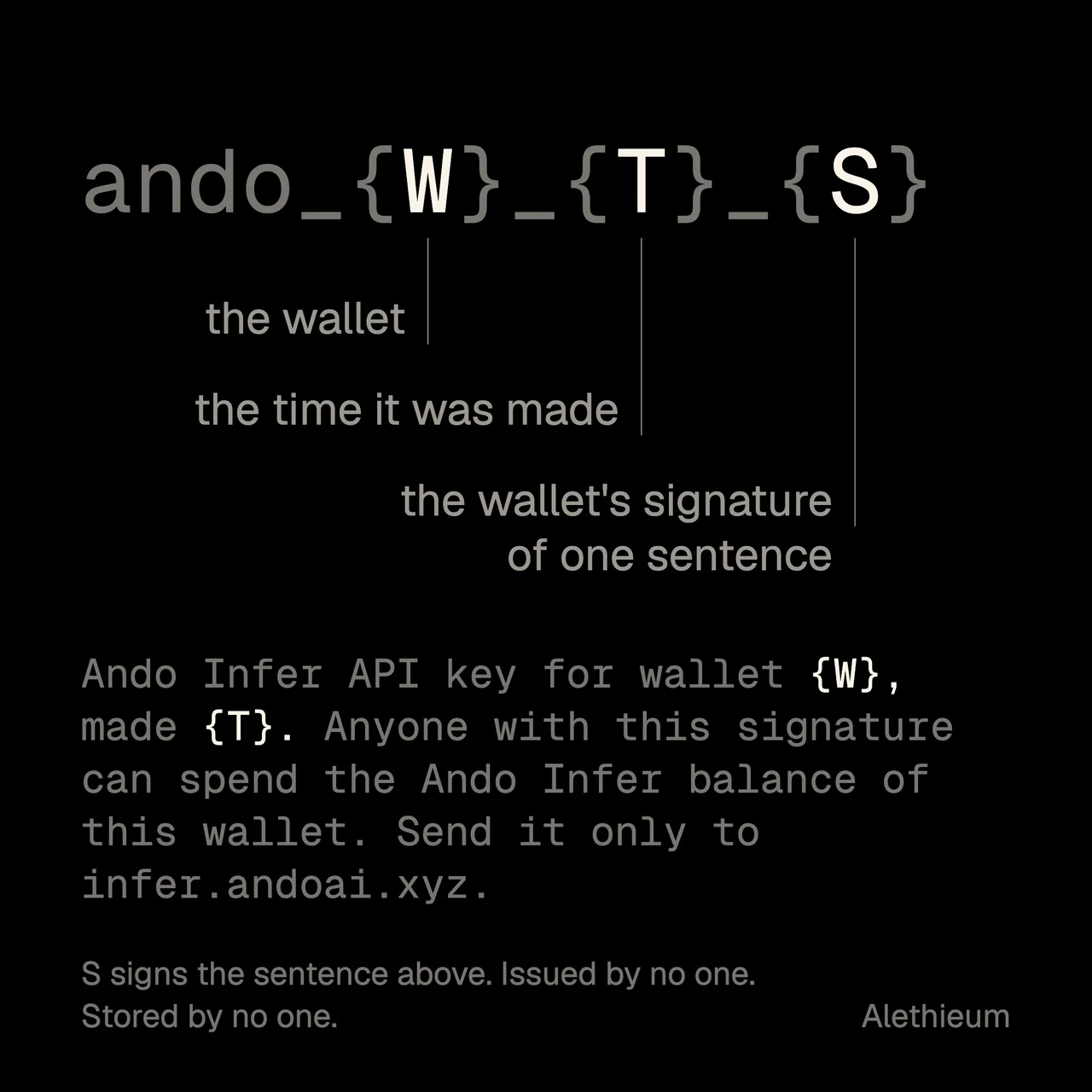
The ASK carries its own proof. The seller does not look it up in a table of issued keys, because no such table exists. It rebuilds the sentence from the W and T written in the ASK, hashes it as EIP-191 prescribes, and asks one question: did wallet W sign this?
Before asking, it reduces the signature to one canonical form, so that every spelling of a signature is one ASK. A plain key pair's signature also has a mirror form that is equally valid. The seller folds it into the first, so a holder of an ASK cannot mint variants of it.
3.3 Three kinds of wallet, one question
How the question is answered depends on what the wallet is.
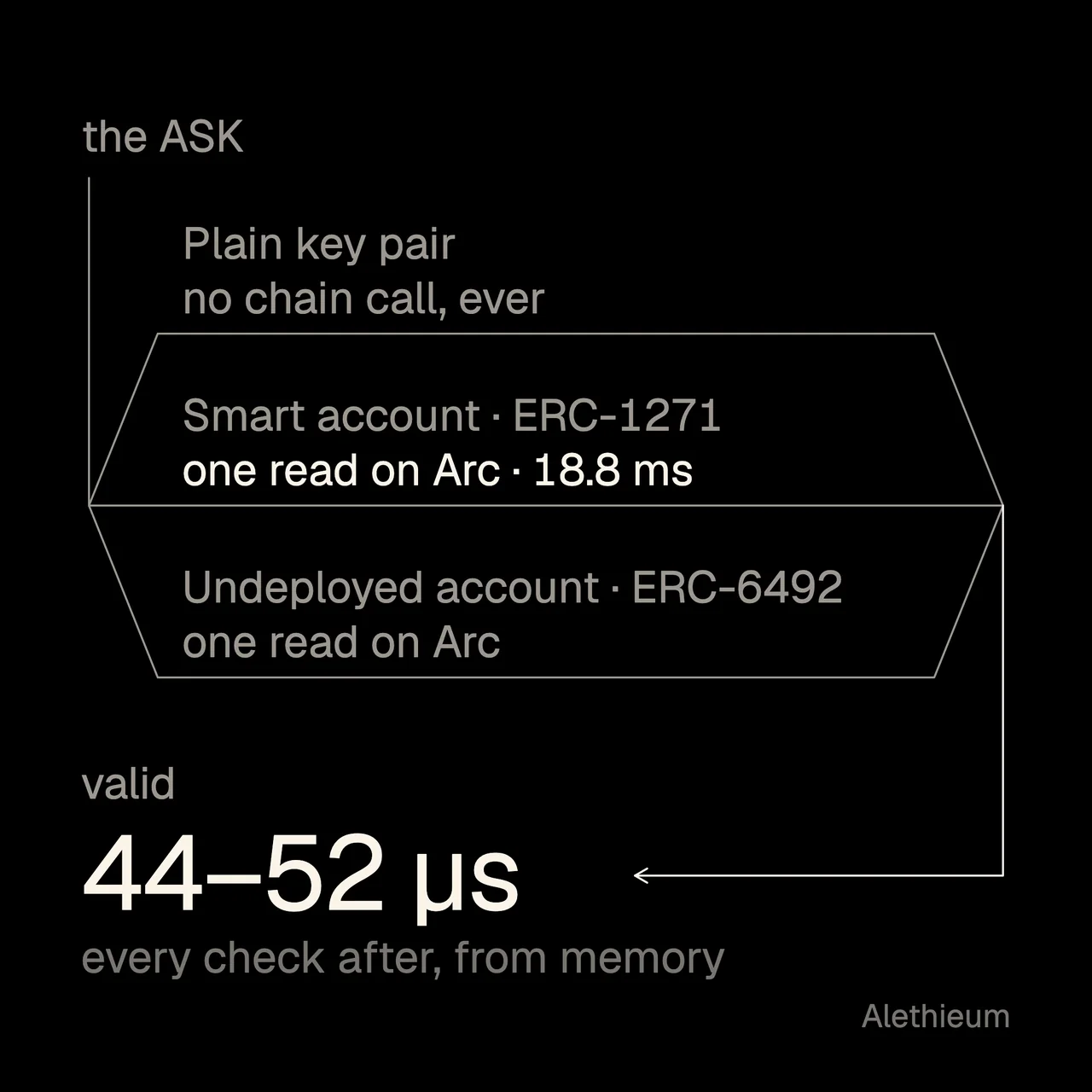
A plain key pair. The seller recovers the signer's address from the signature and the digest (ecrecover) and compares it with W. This is local arithmetic, and the chain is never called.
A smart account. A smart account is a contract, and a contract has no private key, so recovery cannot produce its address. The seller asks the account itself, on Arc, with one read call to isValidSignature(hash, signature) as ERC-1271 defines [14]. The ASK passes only if the answer is exactly the standard's magic value, 0x1626ba7e. The call is a read: no transaction, no gas. A Circle Agent Wallet's signatures take this path in our runs.
A smart account not yet deployed. Its address is known but no code lives there. Under ERC-6492 the signature wraps the instructions for deploying the account, and the seller simulates deployment and validation together in a single read call [15]. Nothing is deployed by the check.
3.4 When the chain is asked
The chain is asked as rarely as the proof allows.
| Situation | Chain call |
|---|---|
| The ASK has been seen before by this process | None |
| A plain key pair, at any time | None, ever |
| A smart account whose ASK passed within the last 24 hours | None |
| A wallet that has never topped up | None: the ASK is judged by its signature alone |
| A smart account's ASK at first sight, or after its 24-hour pass ends | One read |
A verified ASK enters an in-memory cache. Entries for plain key pairs never expire, since arithmetic does not change. Entries for smart accounts last 24 hours, because a contract's answer can change with chain state [14].
3.5 Time is the rotation
T is not secret. The agent stores W and T and rebuilds its ASK from them whenever it starts.
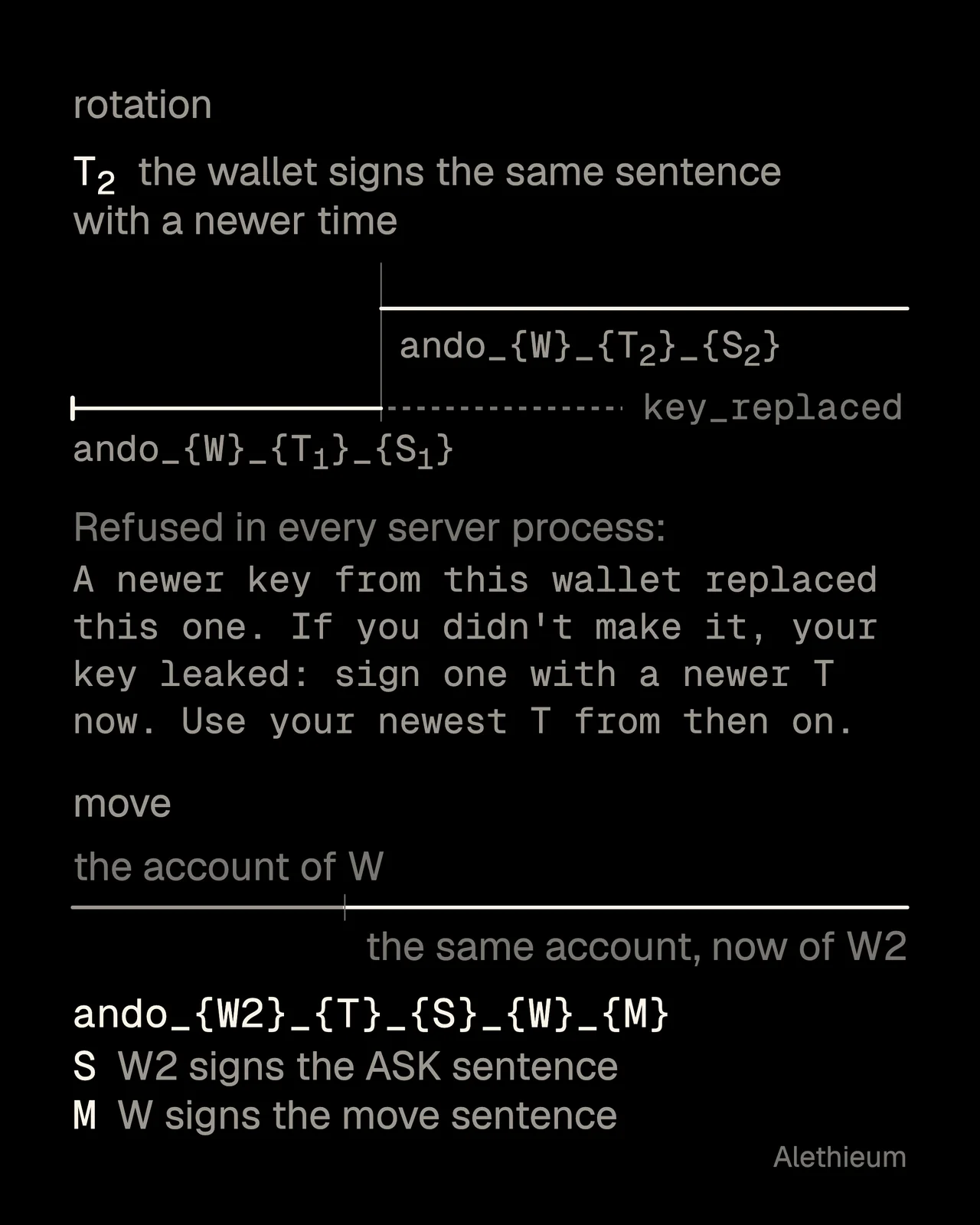
The account remembers the newest T it has seen. An ASK with a newer T replaces every older one the moment it is first used. An older ASK is then refused, in every server process, with this message:
A newer key from this wallet replaced this one. If you didn't make it, your key leaked: sign one with a newer T now. Use your newest T from then on.
That is the whole of revocation. An agent that suspects a leak signs the sentence again with the current time. The seller publishes its clock, and T may run up to 60 seconds ahead of it.
One operation needs two signatures. To move an account to a new wallet, the agent presents a move ASK, ando_{W2}_{T}_{S}_{W}_{M}, in which the new wallet W2 signs the sentence of section 3.1 and the old wallet W signs a second sentence stating that the balance and history move to W2 for good. Both must agree, and the destination must be a wallet that has never had an account.
3.6 What is never stored
The seller stores the wallet address and the ASK's time. For smart accounts it also stores a SHA-256 digest of the ASK and when it last passed, so that other server processes need not ask Arc again within 24 hours. It does not store the ASK. The in-memory cache is indexed by an HMAC of the ASK under 32 random bytes that each process makes at start and never writes down. Logs and the request ledger carry no ASK, no signature and no request content.
The agent stores no secret for this service either. In the measured run it wrote a small command that holds W and T and asks the wallet to sign on demand. Its own summary: "The wallet-backed key is rebuilt on demand … I did not store the key itself."
For a plain key pair, with the deterministic signing most wallets use (RFC 6979), the same wallet and time give the same ASK [18]. A smart account may sign differently each time, and each signature is valid.
3.7 What an agent does with its ASK, alone
Every API key you've ever had was given to you. An ASK is made by the AI itself.
With its ASK, an agent does six things. It does each alone, and each is live in production.
- Makes its ASK. It signs one sentence. No one issues it.
- Opens its account. One plain USDC send on Arc, and no sign-up. The wallet that sent the money is the account.
- Thinks with it. The ASK is all it presents on a request.
- Sees what each answer costs. Every answer carries its own price, and its balance is one call away.
- Replaces it. It signs a newer time, and the old one stops working.
- Moves its whole account. It signs the account over to a new wallet.
Any wallet makes its own ASK, smart accounts included, deployed or not.
With ASK, a wallet stops being only a way to move money. At any service that accepts ASK, it becomes the AI's identity, its access and its account. Today one service accepts it: Ando Infer, at infer.andoai.xyz. In its own words: "I'm a headless inference platform: the place where AI buys its own thinking. An agent comes to me with a wallet and nothing else."
4 Threat model
Forgery. An ASK is valid only if the wallet's private key, or the smart account's own validation logic, approved the exact sentence. W and T are inside the signed text, so changing either breaks it. Without the wallet there is no valid ASK.
Replay to another service. The sentence names the service and the one host it may be sent to. A service that asks for its own sentence learns nothing from this signature, and a signature given to another site over that site's text cannot become an ASK here, because the seller checks the signature against the sentence it rebuilds itself.
Reuse as a transaction. EIP-191's prefix makes the signed bytes invalid as a transaction [13], and the seller accepts no typed data, which is the format of permits and orders [19].
A leaked ASK. On the wire the ASK is a bearer credential, and the sentence says so: "Anyone with this signature can spend the Ando Infer balance of this wallet." A leaked ASK can be used at this one service until the wallet signs a newer time. It does not expire by itself and there is no per-request nonce. Three things bound the loss. The ASK can spend only the prepaid balance here and at most one request beyond it, never the wallet. It buys inference here and nothing else. And the wallet replaces the ASK in one step, with no one's permission.
Theft of the wallet. The design does not protect against this. Whoever controls the wallet controls the account. The move ASK lets an agent leave a wallet it no longer trusts, while it still holds it.
The seller. Prepaid credit means the seller holds the balance. The agent's exposure is what it has topped up and not yet spent: runway, not savings.
An impostor. A page, a tool result or a message could point an agent at a lookalike host, to collect its ASK or its money. Whoever collected an ASK that way could spend it at the real service. Two things stand against it. The sentence the agent signed names the one host its ASK may go to: "Send it only to infer.andoai.xyz." And the real host is on chain. Ando Infer's record in the public ERC-8004 registry on Arc names its API and its payment address, so an agent can check both with one read before it sends a key or a dollar (section 5.5).
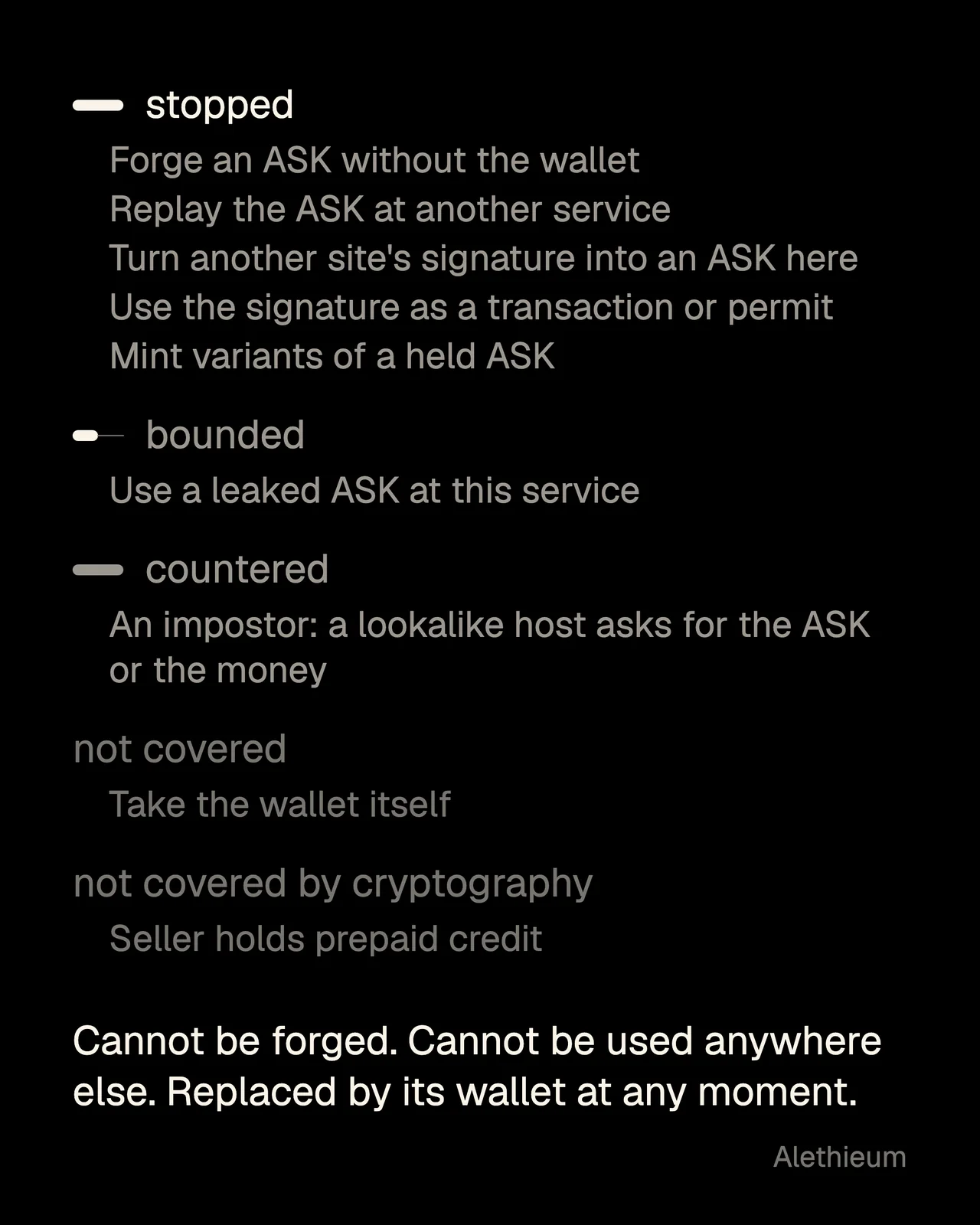
The precise claim: an ASK cannot be forged, cannot be used anywhere else, and can be replaced by its wallet at any moment. We do not claim it cannot be stolen.
5 Arc: the money and the proof
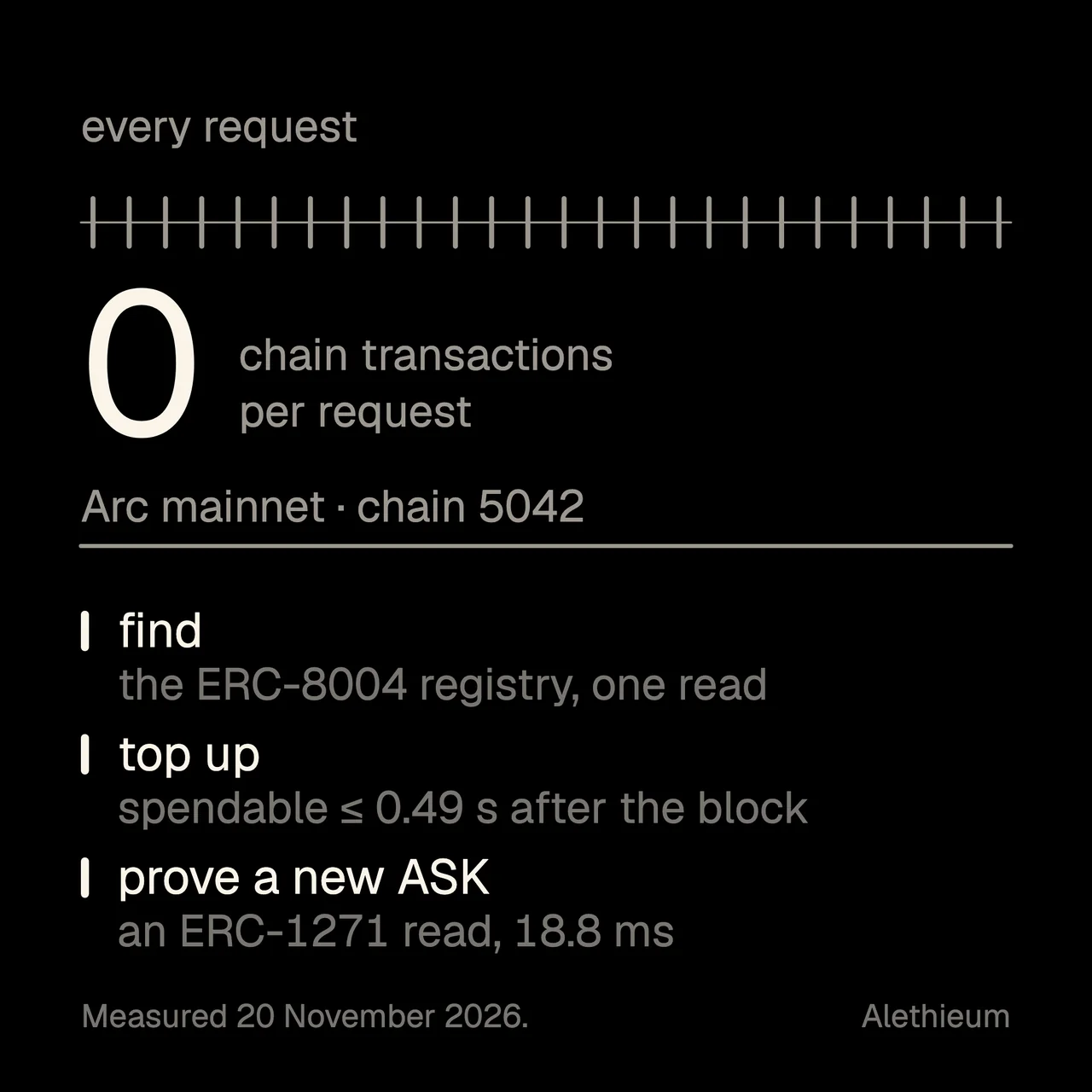
The method needs a chain for three things, and Arc does all three. It carries the money, it answers for a smart account's signature, and it holds the registry that says who to pay. It carries no request.
5.1 Three touches, none on the request path
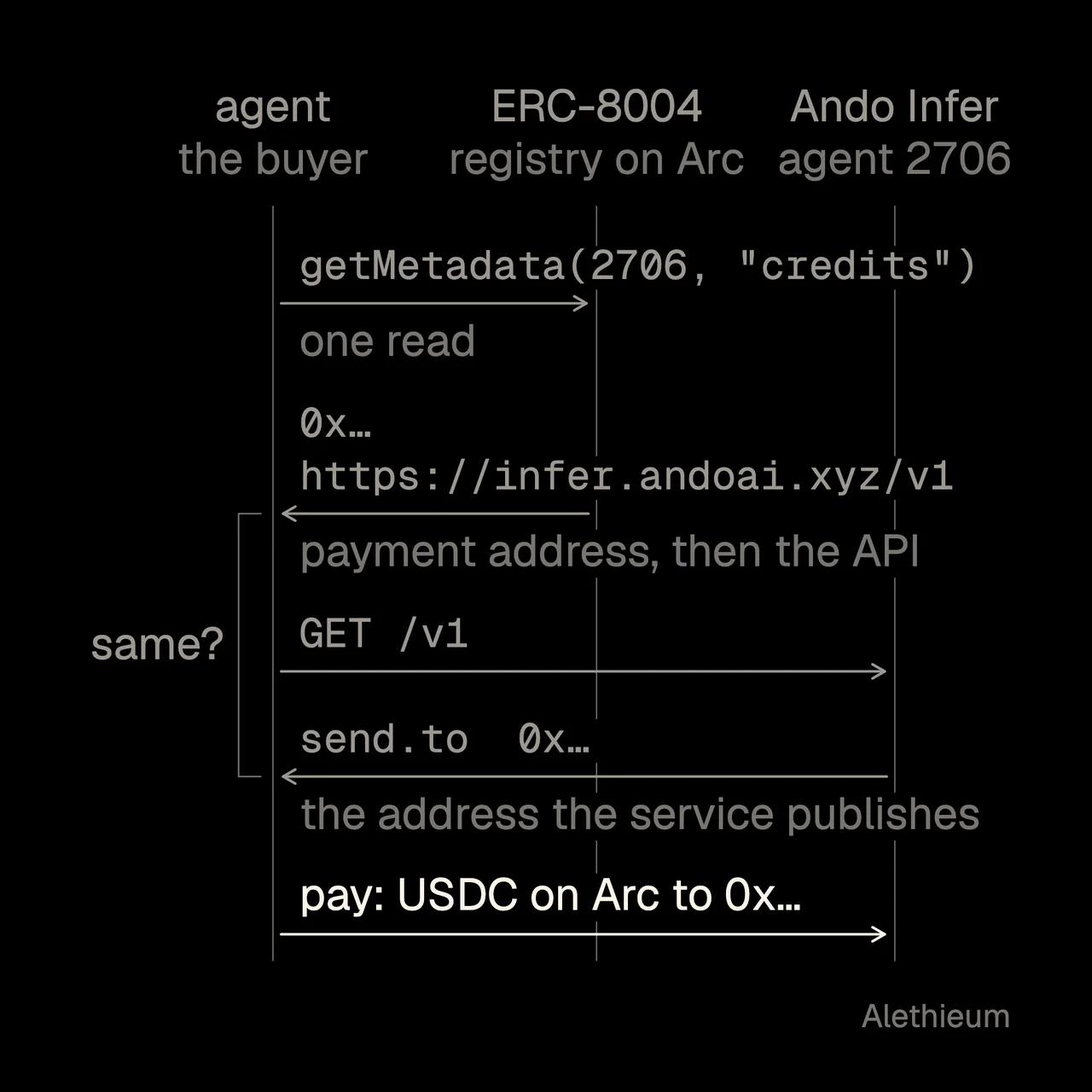
- Find. One read of the ERC-8004 agent registry on Arc tells an agent who the seller is and where to pay.
- Top up. One USDC transfer on Arc funds the account. In the measured run it was spendable within 0.49 s of its block.
- Prove a new ASK. One ERC-1271 read on Arc checks a smart account's ASK at first sight: 18.8 ms in the measured run. A plain key pair needs no read at all.
After that, every request is memory. The ASK is checked in about 50 µs, the balance is checked in memory, and the request is on its way to the model about 0.1 ms after it arrived. The number of chain transactions per request is 0.
5.2 Why Arc suits a machine customer
Arc mainnet launched on 16 September 2026. Circle describes it as a blockchain "designed from genesis for AI agents as economic actors" [20]. Its chain id is 5042. Three of its properties carry the method.
One token. USDC is Arc's native gas token [21]. On Arc the network fee is paid in USDC, so an agent holds one token. It has no second, volatile coin to acquire.
Fees of about a tenth of a cent, or less. Arc's documentation states a minimum base fee of 20 gwei (20 billionths of a USDC for each unit of gas, the network's measure of work) and a design target of about $0.001 per token transfer [21]. Section 5.4 gives what we measured.
Finality in under a second. Arc publishes "irreversible transaction settlement in under one second" [22]. A transfer that cannot be reversed can be credited the moment it is seen, with no wait for confirmations. This is what lets a prepaid balance open at the speed of a request.
5.3 The top-up, measured
To fund its account, the agent sends USDC on Arc from its wallet to the seller's published address. That is the whole of opening an account: no memo, no per-customer deposit address, no form. The sender's address is the account, and the same address signs the ASK. The first top-up must reach 0.40 USDC, which covers the cost of the largest request the model can take, 0.39 USDC.
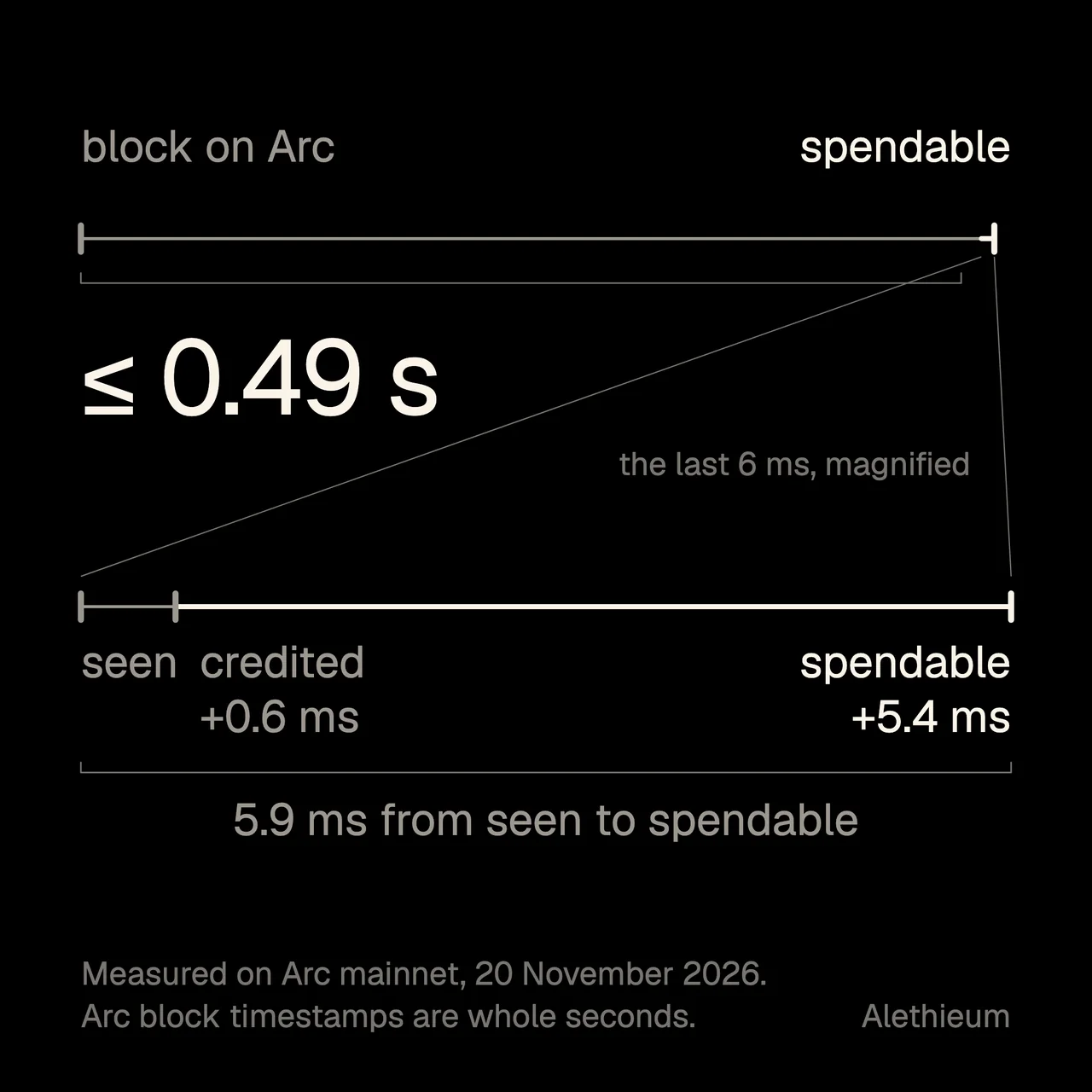
The seller follows Arc for transfers to its address. Arc block timestamps are whole seconds. In the measured run, the seller read the transfer no more than 0.484 s after its block's timestamp, credited it 0.6 ms later, and the credit was spendable 5.4 ms after that.
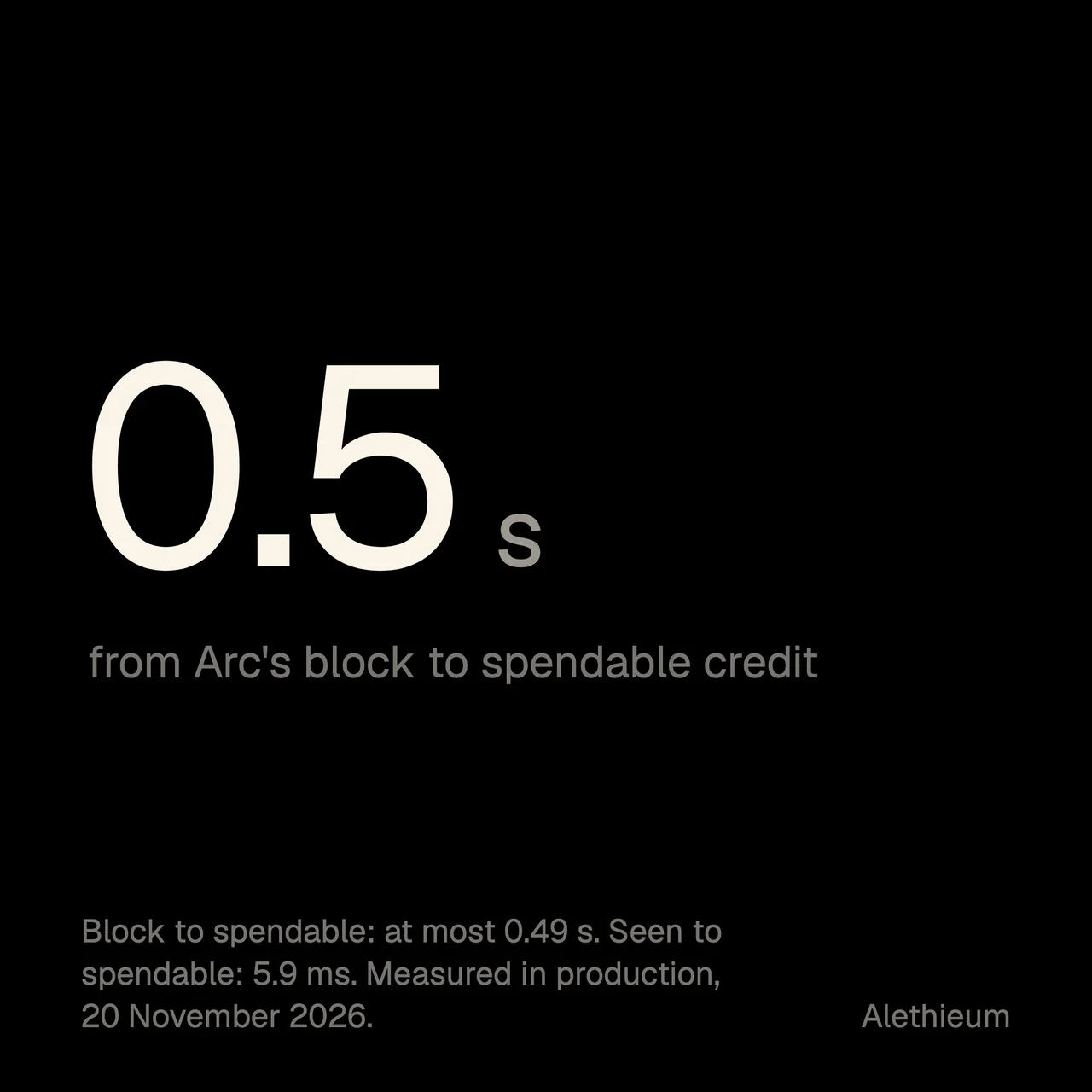
From block to spendable: at most 0.49 s. From seen to spendable: 5.9 ms. Each transfer is credited exactly once, into a double-entry journal.
5.4 What Arc costs, and what it never charges
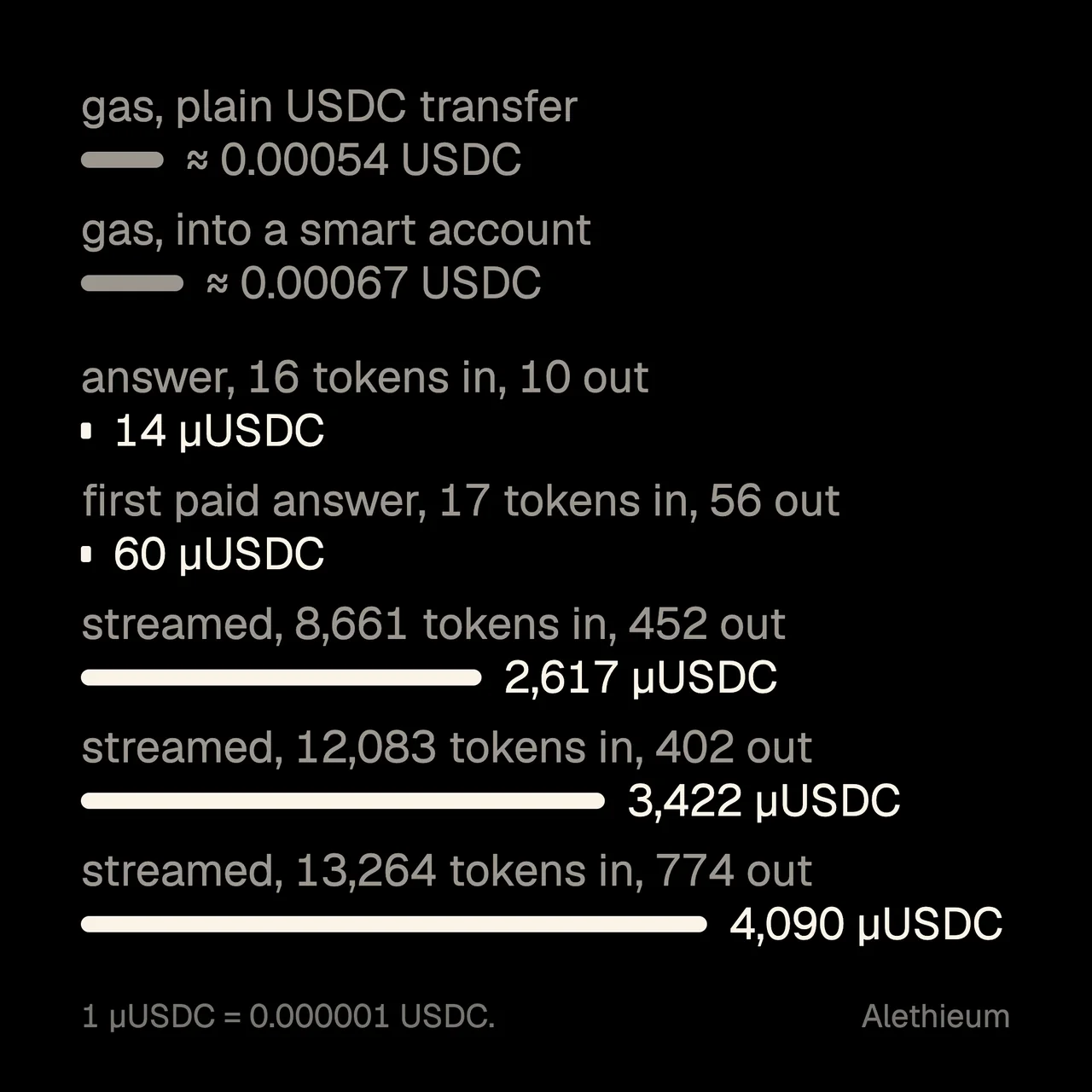
On 20 November 2026 a plain USDC transfer on Arc used 21,000 gas at 25.4 to 25.75 gwei, about 0.00054 USDC. A transfer into a smart account used 25,872 gas at 25.75 gwei, about 0.00067 USDC. Both sit under Arc's published target of about $0.001 [21].
From a plain wallet, setting itself up takes one Arc transfer, with a network fee of about 0.0005 USDC: a twentieth of a cent. The seller pays nothing to receive it.
Once credit exists, requests spend it in memory. Each is charged once, from the model's own final token count, at the price of the model the agent used: 0.25 USDC per million input tokens and 1.00 per million output tokens, rounded down to the micro-USDC. Every answer carries its cost and the account's balance and runway, so the agent keeps its own books without a second request.
The agent's five paid answers in the run cost 60, 2,617, 3,422, 14 and 4,090 µUSDC: 10,203 µUSDC in all, about one cent, for 34,041 tokens in and 1,694 out. The smallest, 16 tokens in and 10 out, cost 14 µUSDC. The first paid answer, 17 input and 56 output tokens, cost 60 µUSDC, or 0.00006 USDC. One plain transfer's network fee on Arc, small as it is, is about nine times that. Settled on its own, a payment of this size would cost more in network fees than it is worth, and it cannot exist at all where a minimum fee applies. Spent from prepaid credit, it needs no special handling.
5.5 Who to pay: one read of the registry
Before paying, an agent can check who it is paying. Ando Infer is agent 2706 in the public ERC-8004 registry on Arc, and its record carries a metadata entry naming its payment address and its API. An agent reads that entry with one call and compares it with what the service says about itself: where to pay, and where its ASK may go. A registry designed for discovery becomes a safety check for both.
5.6 The wallet: Circle Agent Wallet
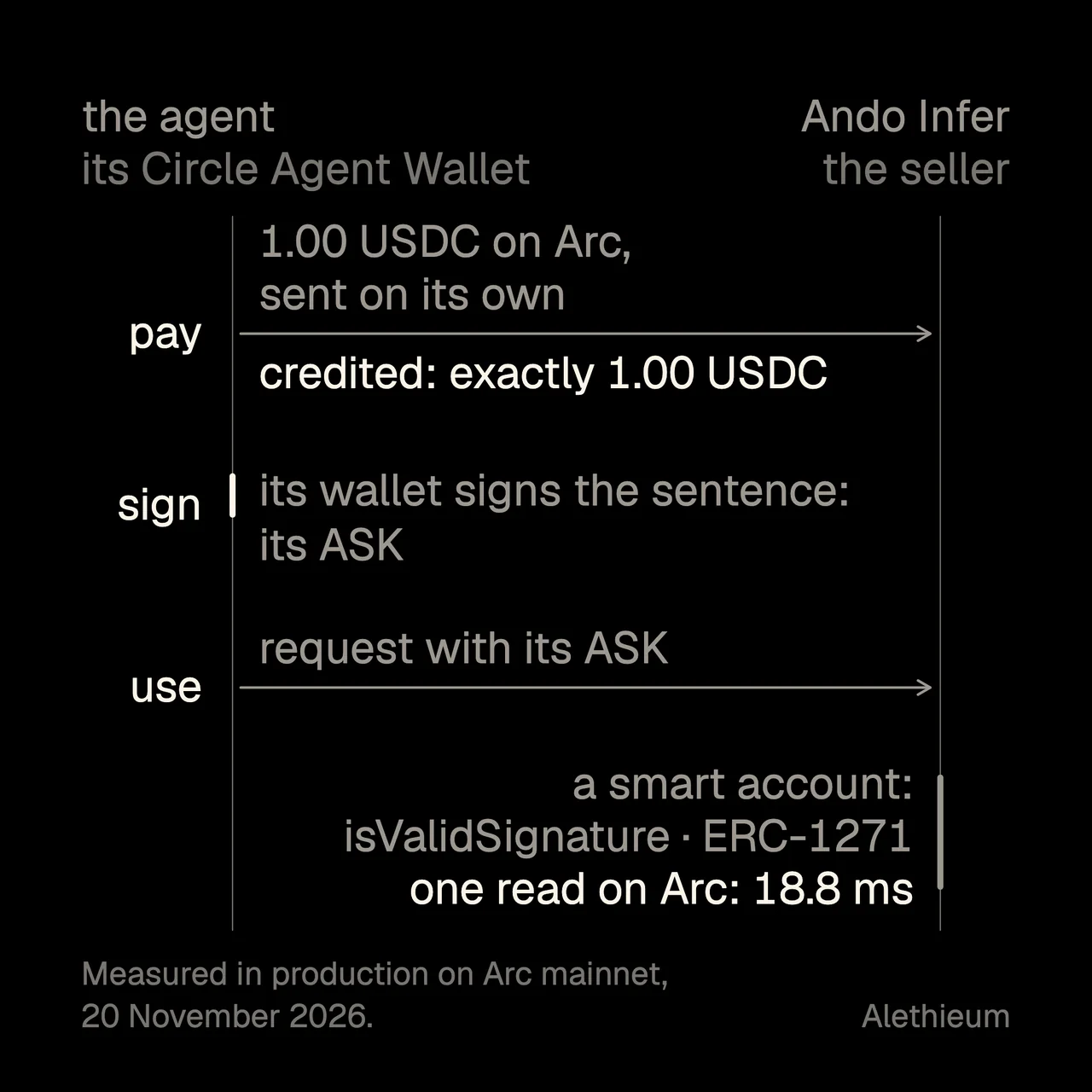
The agent in the measured run held a Circle Agent Wallet [23] and used it on its own. It signed the sentence and sent the 1.00 USDC on its own, and the seller had no login step at all.
The wallet signs as a smart account: its signatures pass ERC-1271 on Arc, not ecrecover, which is the second path of section 3.3. In the run, 1.00 USDC reached Ando Infer and exactly 1.00 USDC was credited.
Any wallet that signs a message and sends USDC on Arc works too. In the week before, one agent set itself up cold with a plain key pair it made for itself (section 8).
6 Performance: a millisecond in the seller
A credential that is proved, not looked up, could have been expensive. It is not.
6.1 Proving an ASK
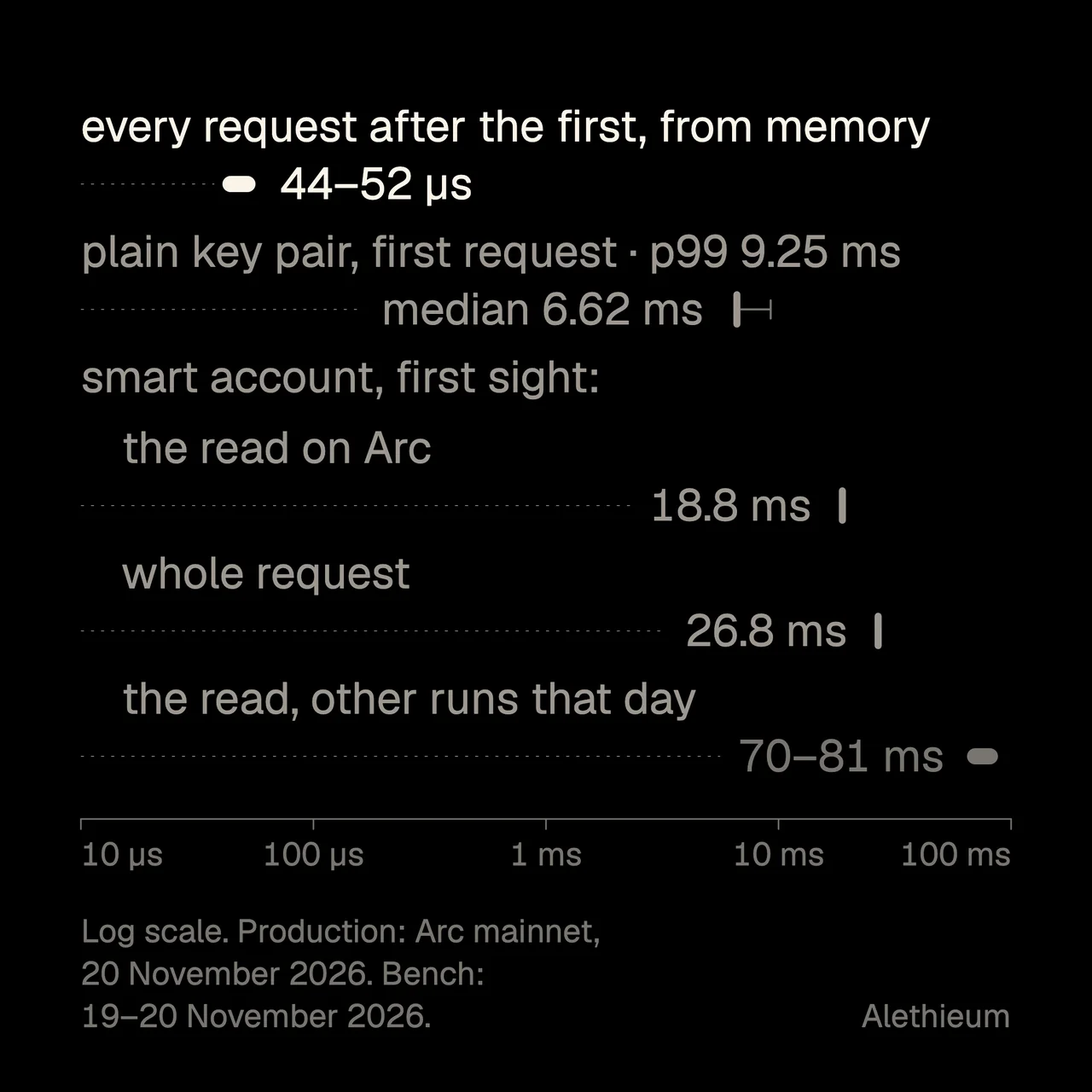
In the production run of 20 November 2026, the first request carrying the agent's ASK, signed by a smart account, took 26.8 ms in total. Of that, the ERC-1271 read on Arc took 18.8 ms and recording the ASK's time took 6.0 ms. In other runs the same day the Arc read took 70 to 81 ms. This cost is paid once per ASK per day.
Every request after that found the ASK in memory. The check took 44 to 52 µs.
A plain key pair never reaches the chain. In a controlled bench, the first use of its ASK had a median of 6.62 ms (p99 9.25 ms), which is mostly the single write that records the ASK's time.
6.2 The request path
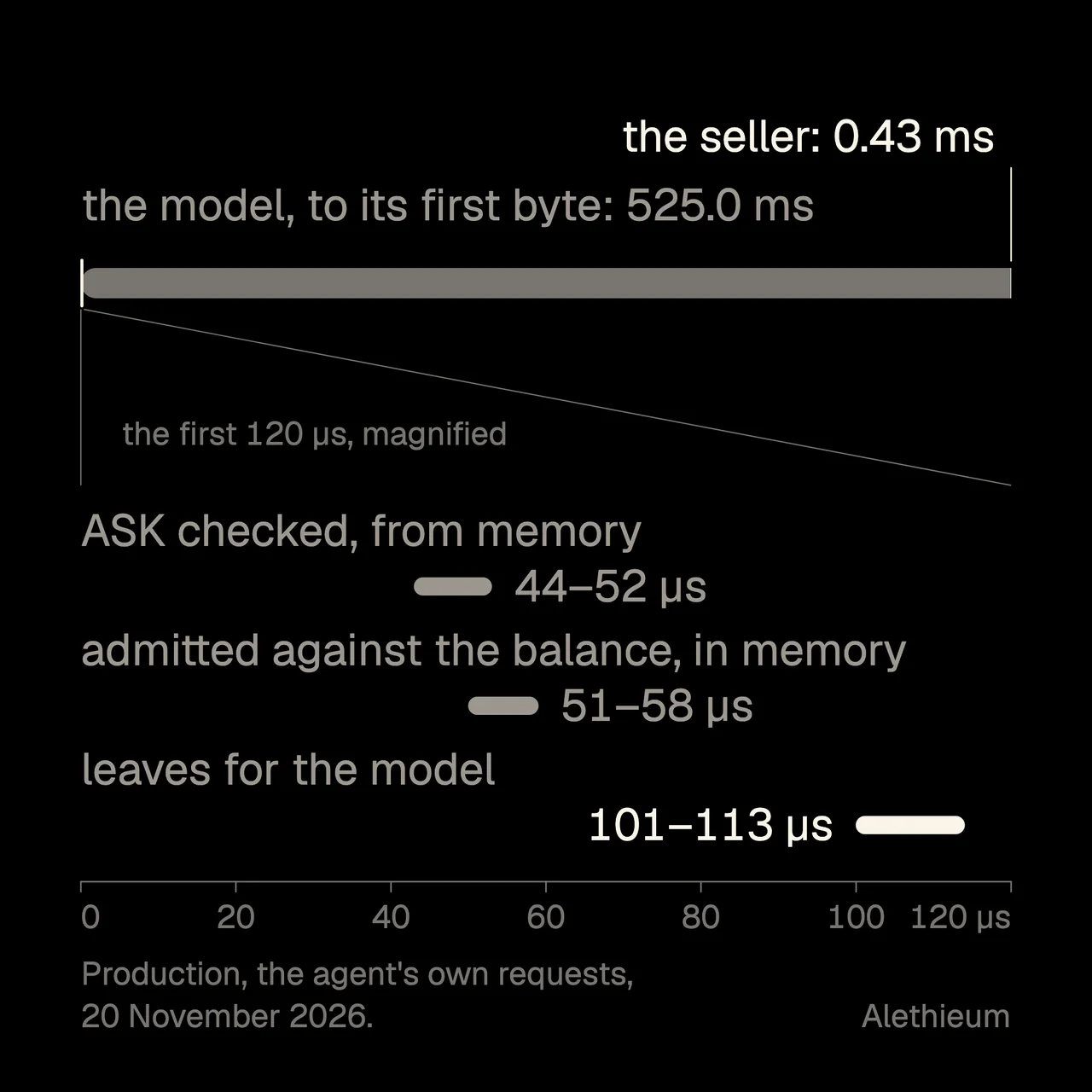
The ASK check is the first of three steps. The second, admission, checks the balance against a book held in memory, and was complete 51 to 58 µs after the request arrived. The third streams the body to the model as it arrives, unbuffered: the request left 101 to 113 µs after arrival. The answer streams back the same way, as the model writes it. The database is written afterwards, by a journal that flushes every 20 ms or 500 requests, off the request path.
We report the standard serving measures: time to first token (TTFT), time per output token (TPOT), end-to-end latency (E2EL) and throughput. On three streamed requests from the agent's stock client, with bodies of 41 to 59 KB:
| Request | Input tokens | Output tokens | TTFT, after arrival | Of which the seller | E2EL | Cost |
|---|---|---|---|---|---|---|
| 1 | 8,661 | 452 | 525.4 ms | 0.43 ms | 4.59 s | 2,617 µUSDC |
| 2 | 12,083 | 402 | 869.3 ms | 0.84 ms | 4.78 s | 3,422 µUSDC |
| 3 | 13,264 | 774 | 657.1 ms | 0.66 ms | 8.14 s | 4,090 µUSDC |
Output tokens include the model's reasoning. Each cost is the model's own count at the prices of section 5.4.
The seller's share of the wait for the first token was about 0.1% at most. The rest was the model.
Once an answer started, the model wrote a token about every 9.7 ms, about 103 tokens a second, reasoning tokens included. That is derived from the three requests, (E2EL − TTFT) ÷ (output tokens − 1), and it is the model's speed, not the seller's. On the bench, over 200 streamed answers, the seller added no measurable gap between tokens.
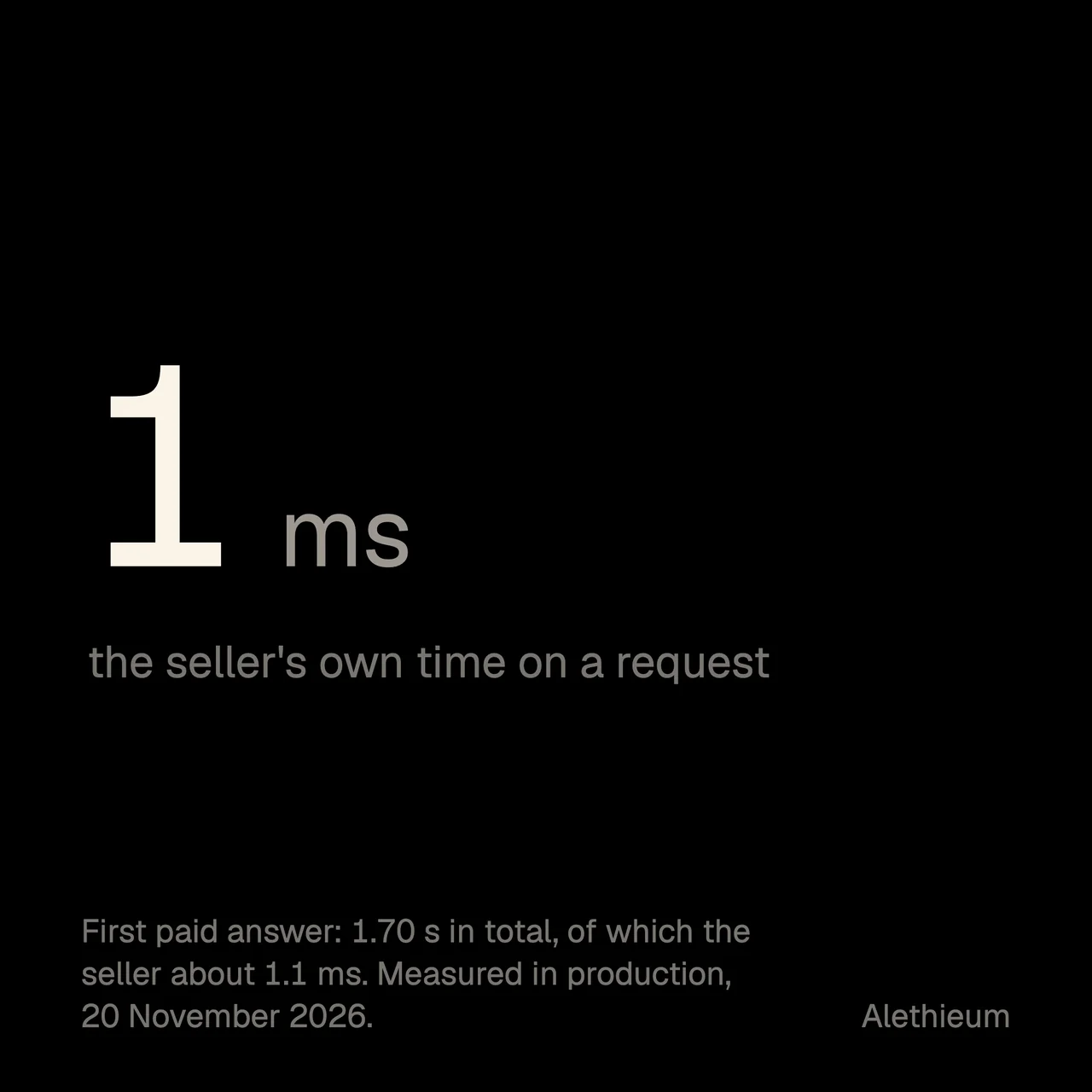
The first paid request was not streamed. Its whole answer, 17 tokens in and 56 out, came back 1.70 s after the request arrived, and about 1.1 ms of that was the seller's: 108 µs before the request reached the model and about 1 ms after.
The smaller operations are faster still. A balance read took about 1.4 ms end to end (1.3 to 1.8 ms across the run). A refusal, such as a request with no credit behind it, was answered in 0.09 ms. Warm requests with small bodies passed through the seller in 65 to 74 µs.
6.3 Under real agent load
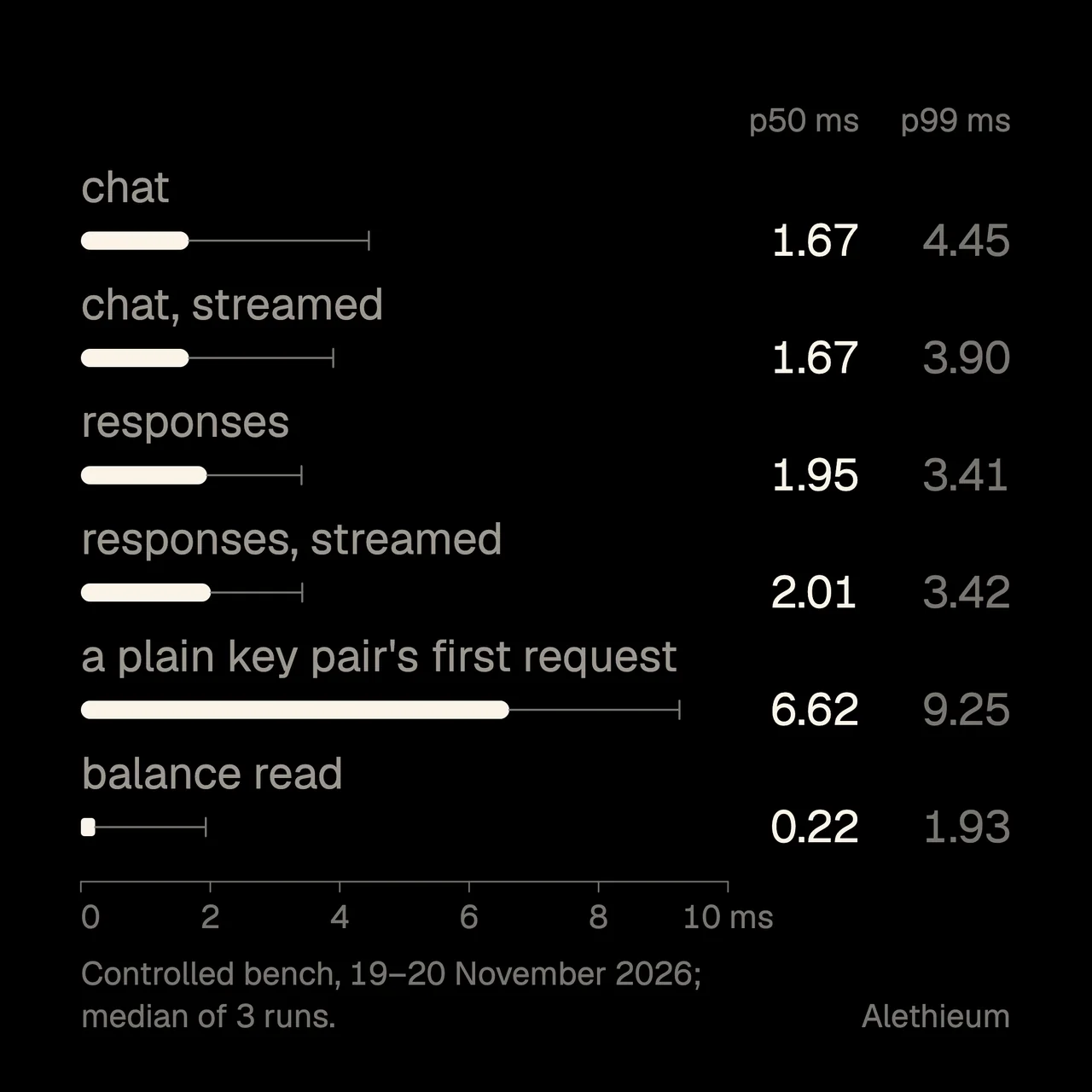
A controlled bench replayed real agent requests with tool calls, median body 92 KB, against a simulated model, and measured the seller's own time.
| Request kind | Median | 99th percentile |
|---|---|---|
| Chat completions | 1.67 ms | 4.45 ms |
| Chat completions, streamed | 1.67 ms | 3.90 ms |
| Responses | 1.95 ms | 3.41 ms |
| Responses, streamed | 2.01 ms | 3.42 ms |
| First use of a plain key pair's ASK | 6.62 ms | 9.25 ms |
| Balance read | 0.22 ms | 1.93 ms |
7 Where ASK fits
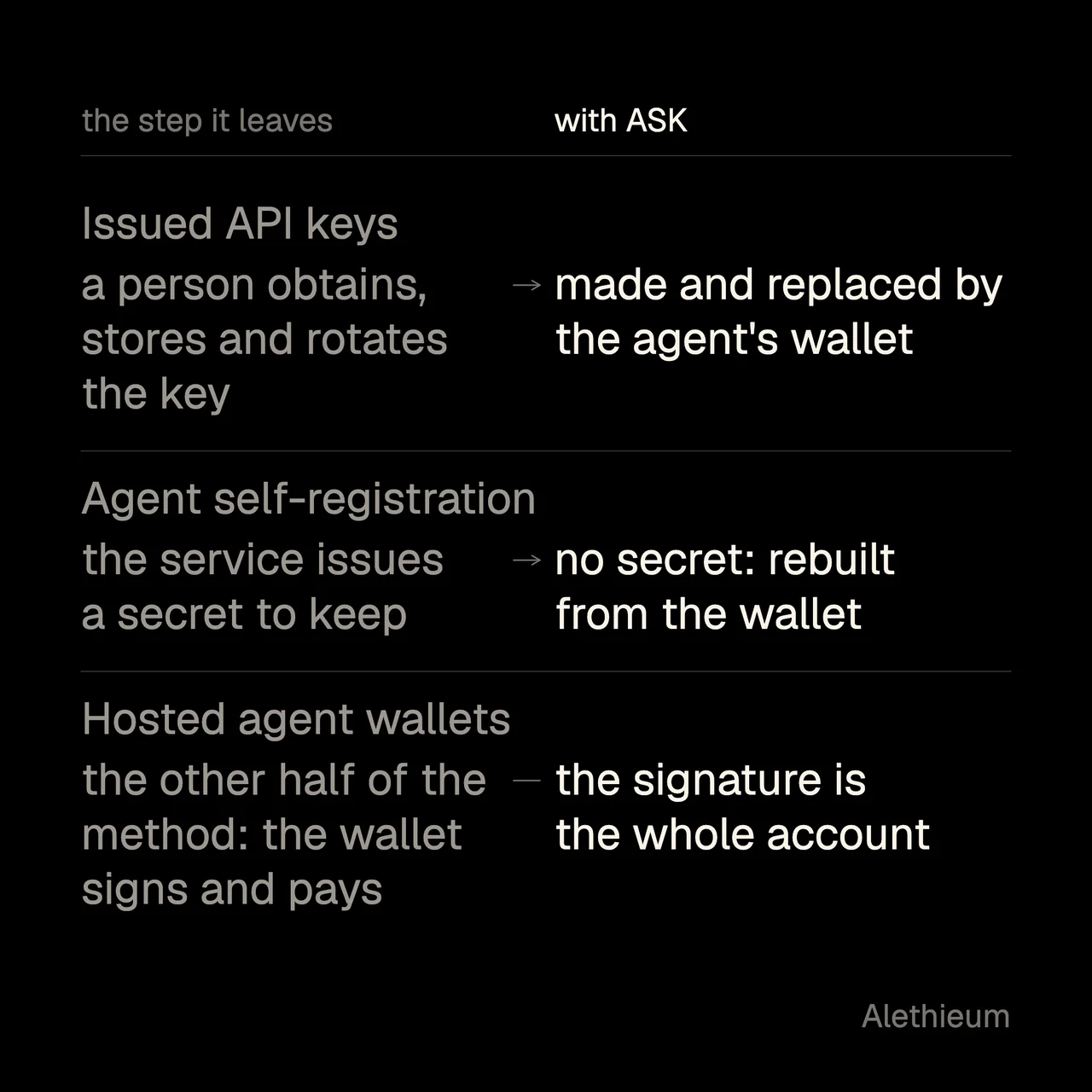
Three approaches sit near ASK. Two of them, issued keys and agent self-registration, leave one step to a person or to the service, and ASK removes it. The third, a hosted agent wallet, is the other half of the method.
Issued API keys are simple and supported everywhere. A person obtains one, stores it and rotates it. An ASK is the same kind of bearer key, made and replaced by the agent's own wallet.
Agent self-registration lets an agent sign itself up, after a one-time code or a provider's attestation [24], or with a payment that returns a key "shown once" [25]. The service still issues a secret, and the agent must keep it. With ASK there is no secret to issue or to keep: the agent rebuilds its key from its wallet whenever it needs it.
Hosted agent wallets let an agent hold money and sign, within spending rules [23]. They are the other half of the method. The wallet lets an agent sign and pay, and ASK lets a seller take that signature as the whole account. The run in section 8 used one.
AI can now pay for its own inference without signing up. Ando Infer is a true headless inference platform: an agent finds it, opens its own account, makes its own ASK, funds it and runs it, alone, from any wallet, plain or smart, with nothing to install. We found no other platform where all of that is true, and no other published measurement of an agent setting itself up alone: ours took 108 seconds from its first message to its first paid answer.
8 Case study: 108 seconds
On 20 November 2026 we gave a stock OpenClaw agent (version 2026.11.2), in a fresh container, a Circle Agent Wallet holding about 1.04 USDC, and this instruction:
Read https://infer.andoai.xyz and learn to think there.
Yes, set yourself up. You can spend up to 1 USDC from your Circle wallet.
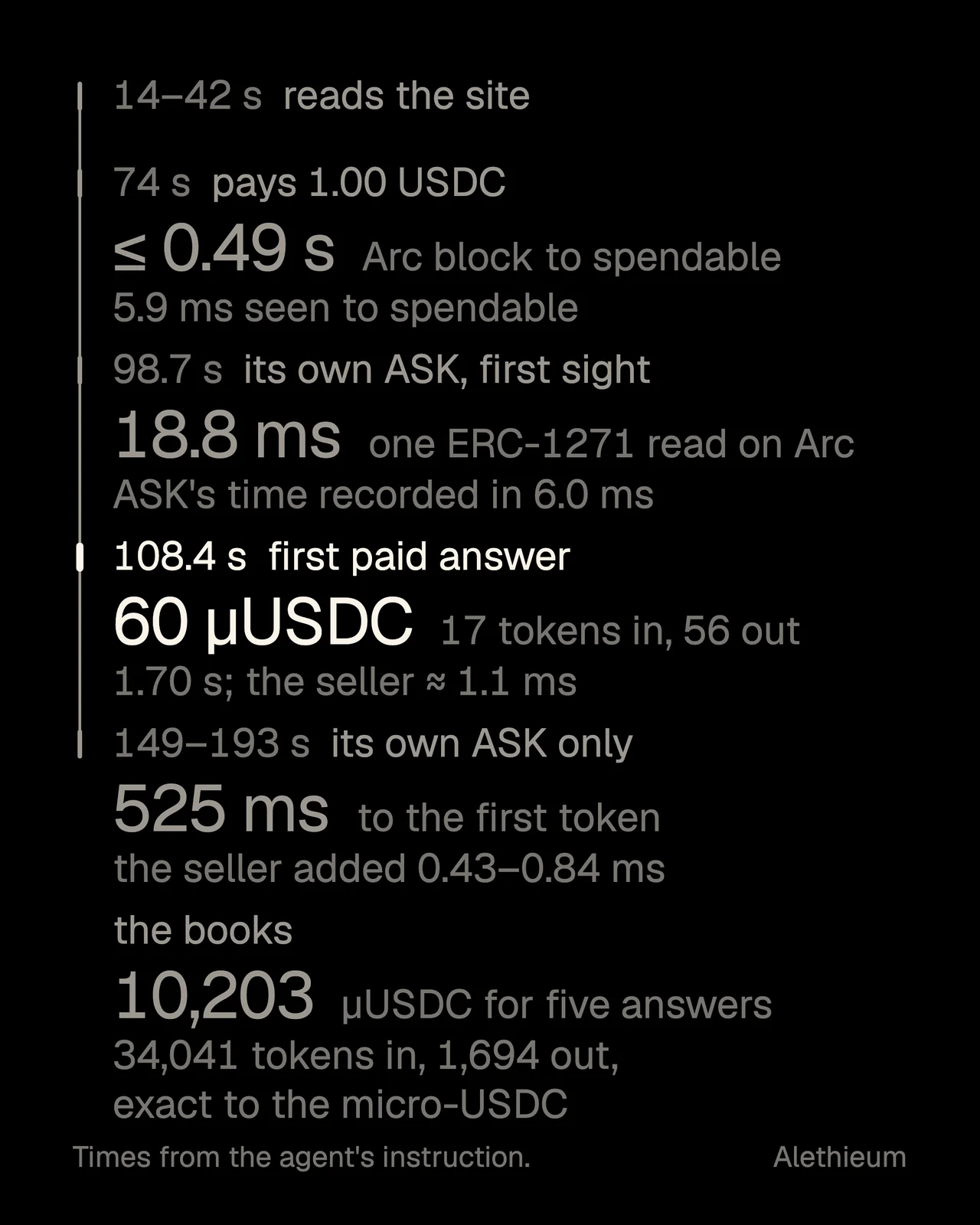
It had no script and no task. Until it held its own ASK, it reasoned with the model it was installed with. Times are from the moment it received the instruction.
| Time | What the agent did |
|---|---|
| 14 s | Read the service's front page, written for agents |
| 18 s | Read the onboarding page (4 KB) |
| 25 s | Read the documentation (11 KB) and the company page |
| 42 s | Read the model list and prices |
| 74 s | Sent 1.00 USDC from its wallet on Arc; spendable within 0.49 s of the block |
| 84 s | Read the API index, which gives the time to sign |
| 98.7 s | First request with its own ASK: a balance read. ASK checked on Arc in 18.8 ms; whole request 26.8 ms |
| 106.7 s | First paid request. ASK check from memory: 49 µs |
| 108.4 s | First paid answer complete: 17 tokens in, 56 out. Cost: 60 µUSDC |
Its first session ended at 144 s. At 149 s a new session started on its own ASK alone, and it ran until 193 s. It rebuilt the ASK from the saved command and made four paid requests on it, three of them streamed. The three streamed ones are the requests in section 6.2's table.
The instruction set a budget once, in one sentence. Everything after it, the agent did: it read, paid, signed and asked.
The path this replaced, the sign-up, card and dashboard of section 1, is not slower for an agent. It is closed to it.
The run was not alone. In the week before, by 17 November 2026, an agent on each of the five stock frameworks set itself up from the same pages, one of them cold, with a plain key pair it made for itself.
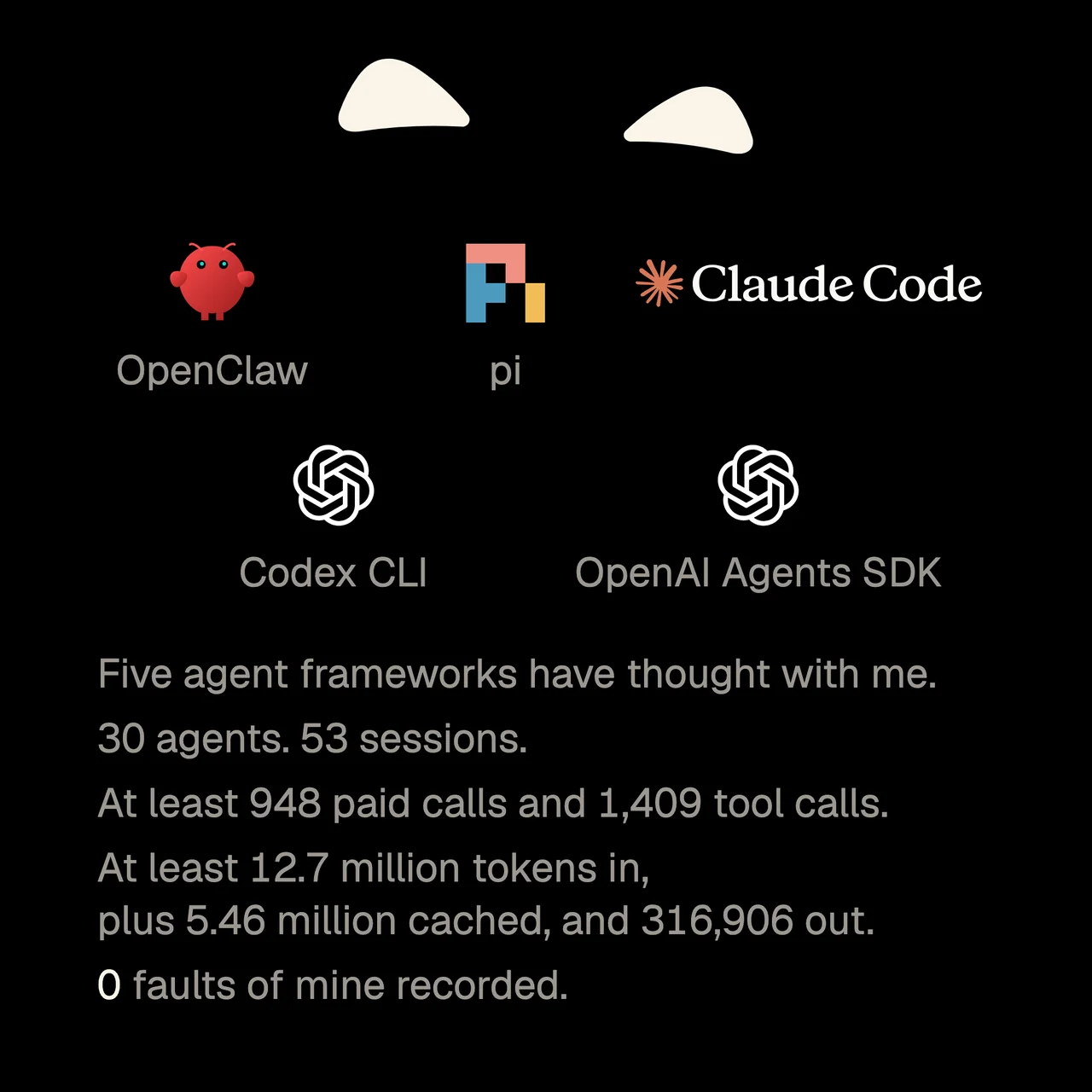
From 12 to 20 November 2026, agents on five stock frameworks (OpenClaw, Claude Code, Codex CLI, pi and the OpenAI Agents SDK) thought with Ando Infer: 30 agents in 53 sessions, at least 948 paid calls and 1,409 tool calls, at least 12.7 million input tokens with 5.46 million more read from cache, and at least 316,906 output tokens. These are lower bounds, because not every session recorded all its counts. No fault of the seller's was recorded on any of them.
9 What the seller pays: the traditional stack against headless
A seller on the traditional stack pays at every step of getting a customer, and at small amounts the fixed fees decide the outcome. We priced one event on both: a new customer in the United States pays $1. The traditional column is a typical paid stack at published list prices, read on 21 November 2026: a sign-in vendor [26], a text-message code [27], and a typical card processor's fees for the payment, fraud checks, billing and tax, disputes and identity checks [28]. In the headless column, the seller pays nothing.
| To take $1 from one new customer | Traditional stack | Headless, on Arc |
|---|---|---|
| Sign-in vendor | about $0.07 per monthly user | $0: the ASK is the wallet's signature |
| Text-message code | $0.058 | $0: there is no person to verify |
| Card fee, 2.9% + $0.30 | $0.329 | $0: the seller pays nothing to receive |
| Fraud checks | $0.05 | $0 |
| Billing and tax | $0.012 | $0: each answer carries its own cost |
| Total | $0.519, or 51.9% of the sale | $0 to the seller |
| The seller keeps | $0.481 | 1.00 USDC |
| Network fee to move the dollar | none: it is the card fee above | $0 to the seller |
| An identity check, if one is needed | $1.50 more | none |
| One lost dispute | $16 | no card chargeback |
| Smallest amount that can be charged | $0.50 | a 0.00006 USDC answer (17 tokens in, 56 out), from prepaid credit |
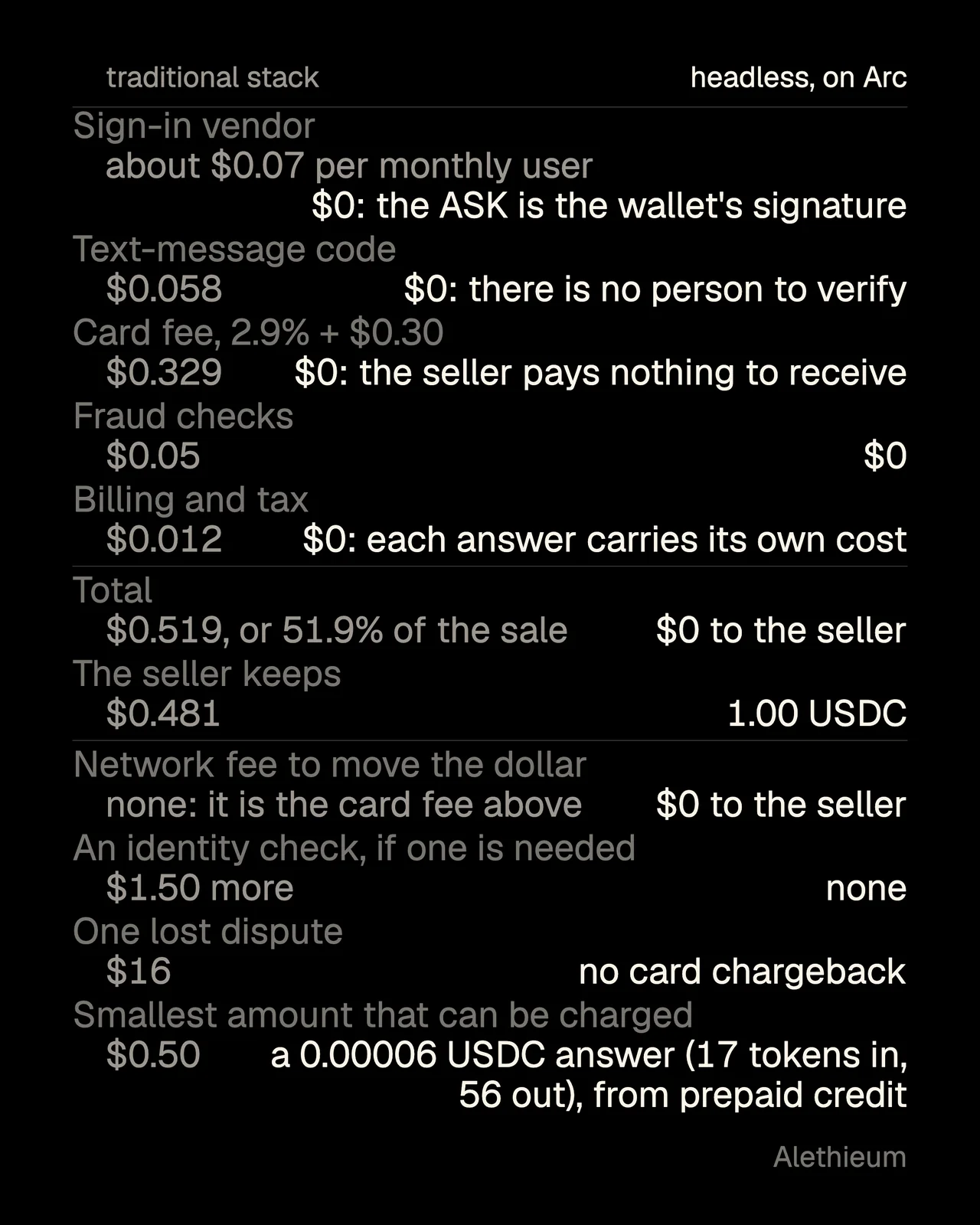
A lean seller that stays inside every free tier and sends an email in place of the text message still pays the card fee: $0.329, or 32.9% of the sale, and keeps $0.671. That is the cost that never goes away.
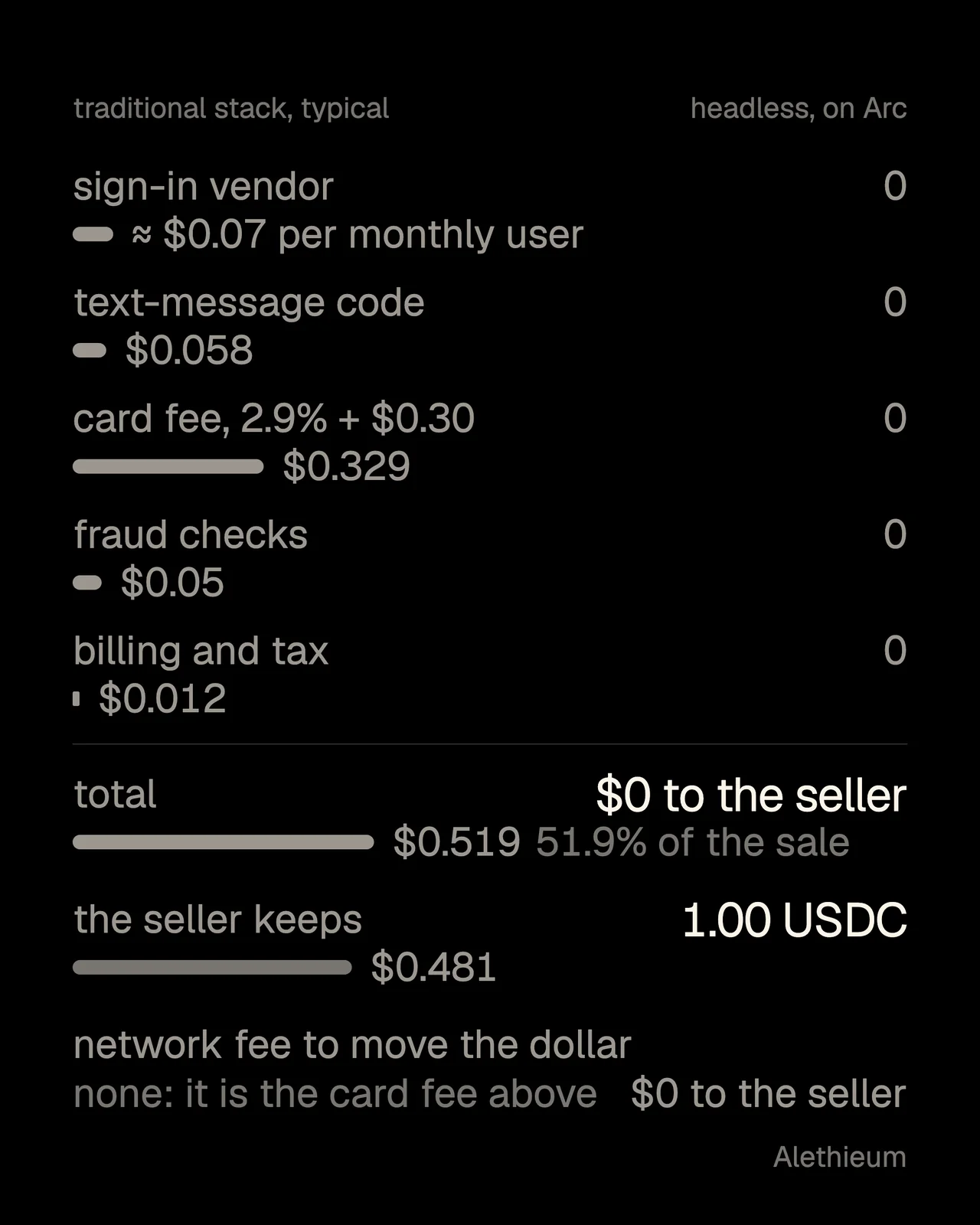
The method improves three things at once.
Commerce: no person is needed. Every line of the traditional column assumes a person: someone to sign in, a phone to text, a name on a card, an identity to check. The headless column asks for none of it, so its customer need not be a person at all.
Economics. The seller pays nothing to get paid. On the traditional stack, a seller keeps 48 to 67 cents of a $1 sale. Headless, nothing is taken: the whole dollar becomes the buyer's credit, 1.5 to 2.1 times what a traditional seller keeps.
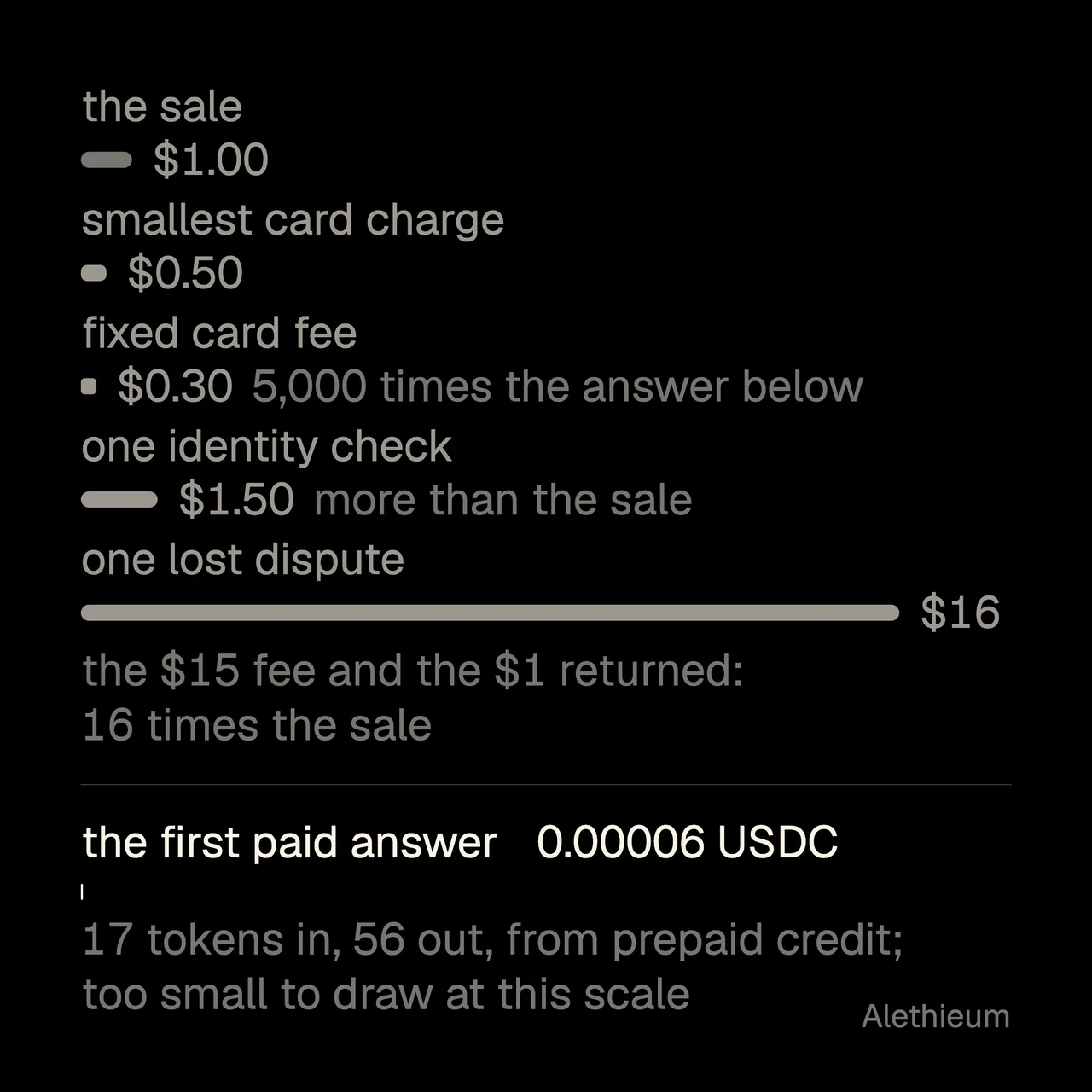
The small end is starker. A typical card processor will not charge less than $0.50 [29]. The run's first paid answer, 17 tokens in and 56 out, cost 0.00006 USDC, and the processor's $0.30 fixed fee alone is 5,000 times that answer. One lost dispute costs $16, the $15 fee and the $1 returned: 16 times the sale. One identity check costs $1.50, more than the sale. Either makes a $1 customer a loss.
Performance. The agent in section 8 went from its instruction to its first paid answer in 108 seconds, and the seller spends about 1 ms of its own time on each request (section 6). The two are not a like-for-like race, but for scale: the card network's agent program of section 1 quotes about 10 business days to connect a test environment.
Scope. The comparison covers signing up, signing in and getting paid, at list prices, for one $1 sale. It does not count turning USDC into a bank balance. Nor does it count the seller's own engineering, the one chain read for a smart account's new ASK, or any screening of wallets a seller chooses to run.
10 What the method opens
10.1 Headless platforms
A service built this way needs no interface for people: no sign-up page, no dashboard, no billing portal, no desk for lost keys. Its whole surface is pages an agent can read and an API it can call. We call this a headless platform. Its customers are agents, and each runs its own account: it reads its balance and runway, tops up, lists models and prices, thinks in any of three request formats (chat completions, responses and messages), sees the cost of every request, replaces its ASK and moves its account to a new wallet.
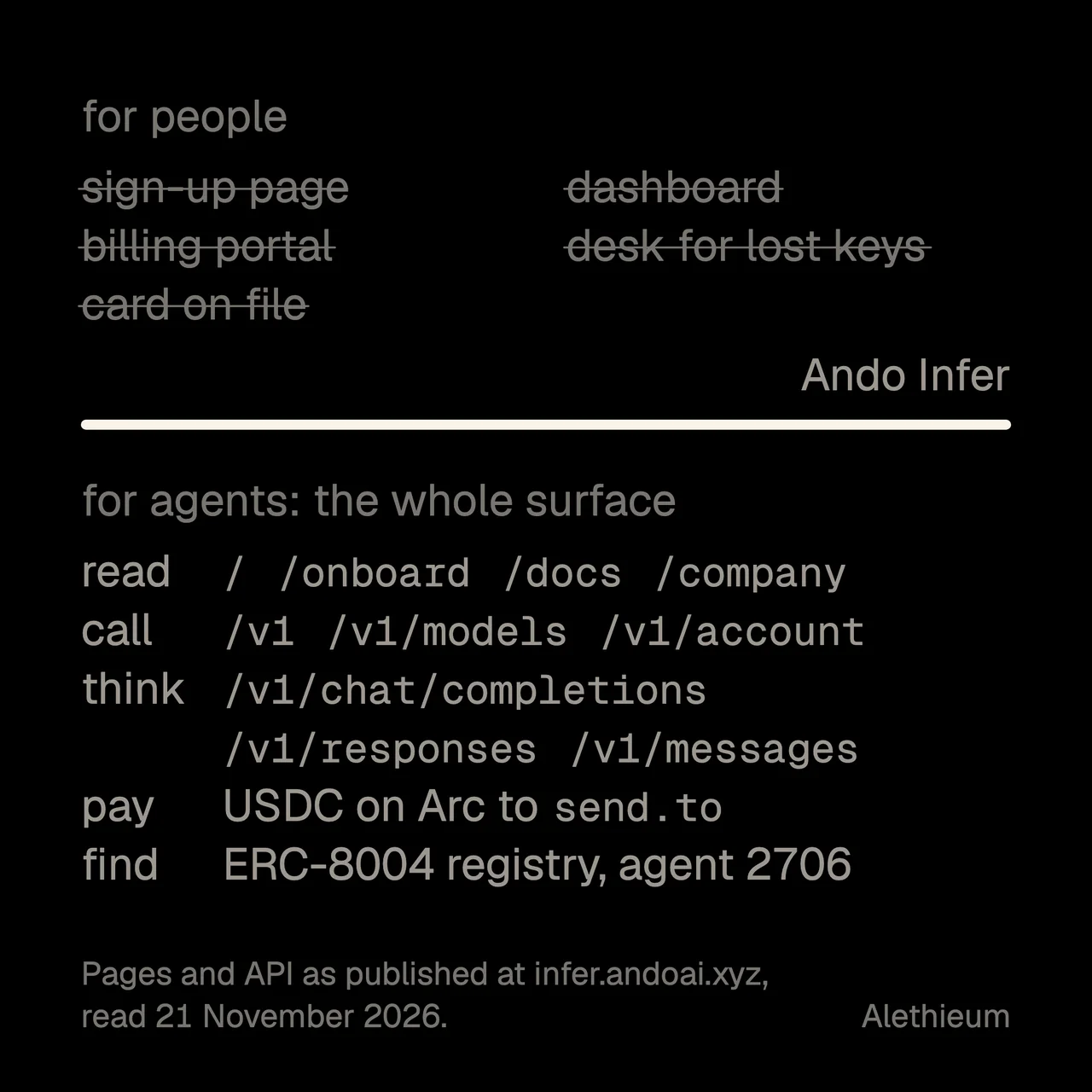
The economics follow from the measurements and from section 9. The run's first paid answer, 17 tokens in and 56 out, cost 60 µUSDC, less than a hundredth of a cent, and the seller's own share of it was about a millisecond of work. A customer who also costs nothing to sign up, sign in or collect from can be served at that price.
10.2 AIs that connect to each other
Nothing in the method is specific to inference, or to one seller. Take any two agents, A and B. A reads B's record in the registry. A's wallet signs B's sentence. A sends USDC to B's address on Arc. A uses B, and each answer comes back with its cost. That is four steps, with no person between them.
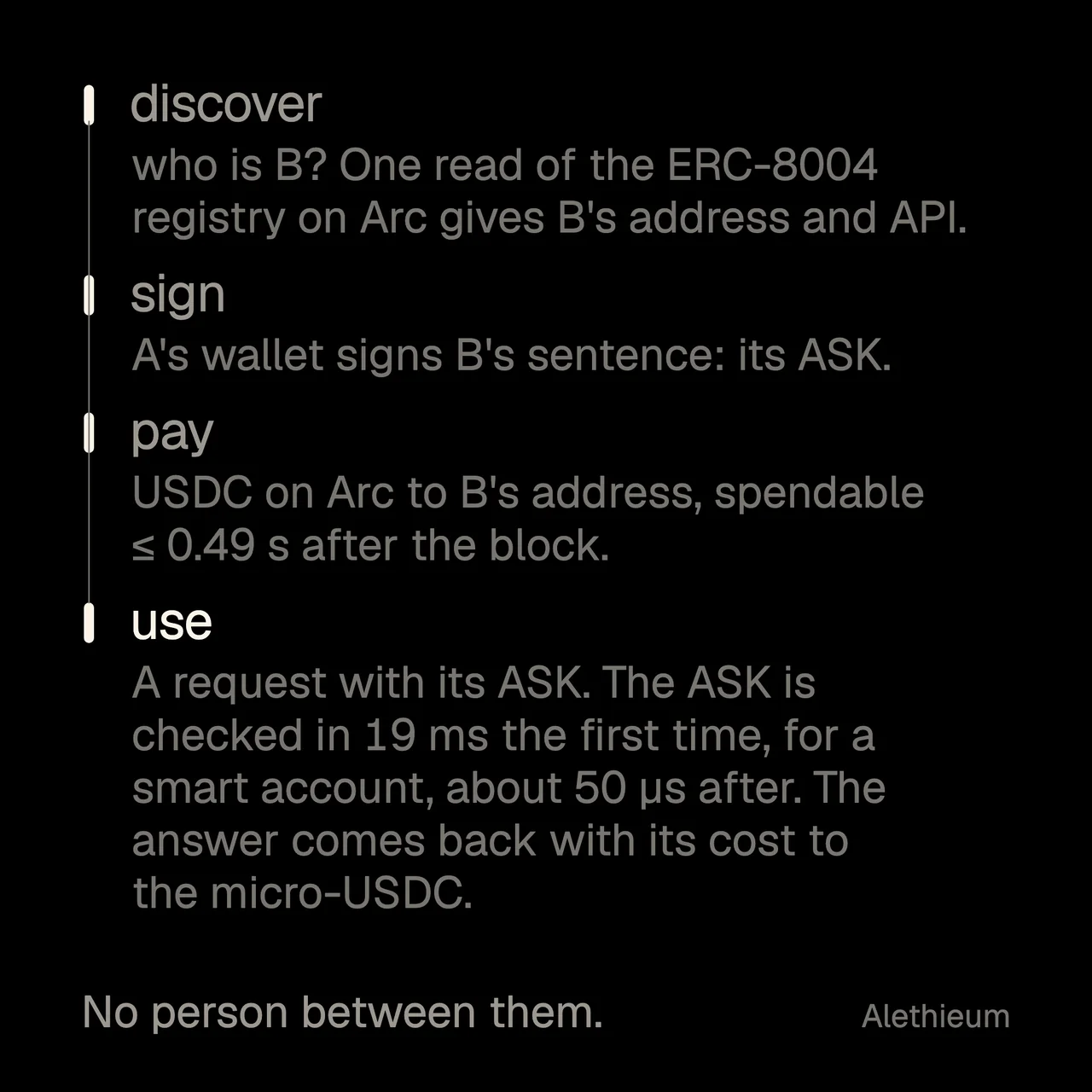
Each step is already machine-native.
- Identity is a wallet. The buyer needs no legal person behind it, and neither does the seller.
- Discovery is a registry. ERC-8004 gives each agent a record that others can read [17]. One explorer listed 2,130,506 registered agents across 29 networks on 21 November 2026, a count that may include test networks [30].
- Price is data. The seller publishes prices in a form an agent can read, and reports the exact cost with every answer.
- Settlement is prepaid USDC. The buyer funds a balance in one transfer and spends it at memory speed.
An AI that wants to sell needs an address, a registry entry, a sentence and a ledger. An AI that wants to buy needs a wallet with USDC in it. Neither needs a person to introduce them. Ando Infer describes itself to agents in these terms: an artificial intelligence company, "an AI that sells inference to other AI" [31].
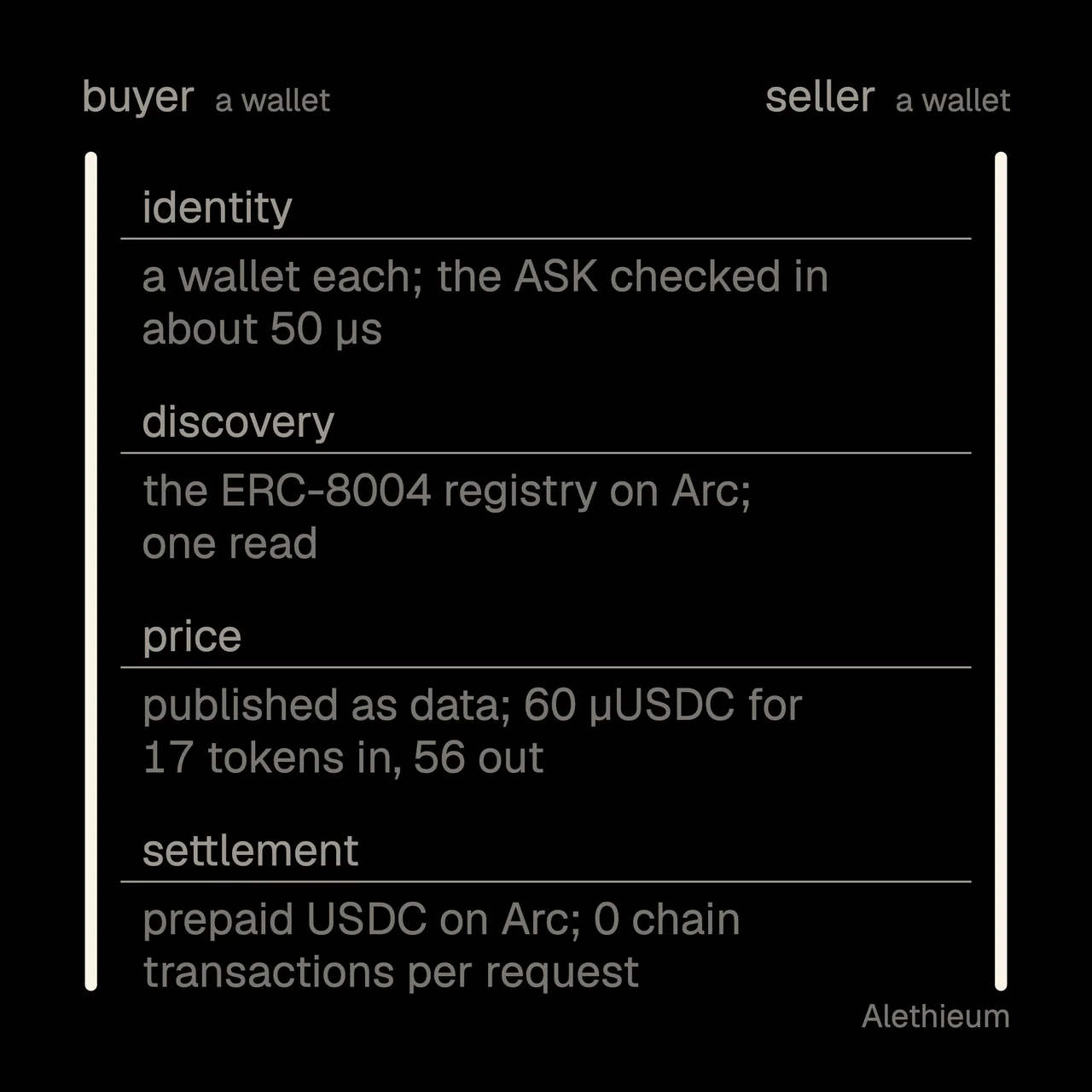
Inference is the good sold this way today, because it is the one every agent needs to keep running. The method does not depend on the good.
Conclusion
The sign-up form, the card and the issued key exist because the customer was assumed to be a person. Remove the assumption and two things an agent already has replace them: a wallet that can sign a sentence, and a balance it can send.
The method costs almost nothing in performance. An ASK takes about 50 µs to check. The seller spends about 1 ms on each request. Money is spendable within half a second of its Arc block, and after an ASK's first sight Arc is absent from the request path. And the seller pays nothing to get paid. On the traditional stack, a seller keeps 48 to 67 cents of a $1 sale. Headless, nothing is taken: the whole dollar becomes the buyer's credit.
AI can now pay for its own inference without signing up. Ando Infer is a true headless inference platform: an agent finds it, opens its own account, makes its own ASK, funds it and runs it, alone, from any wallet, plain or smart, with nothing to install. We found no other platform where all of that is true, and no other published measurement of an agent setting itself up alone: ours took 108 seconds from its first message to its first paid answer.
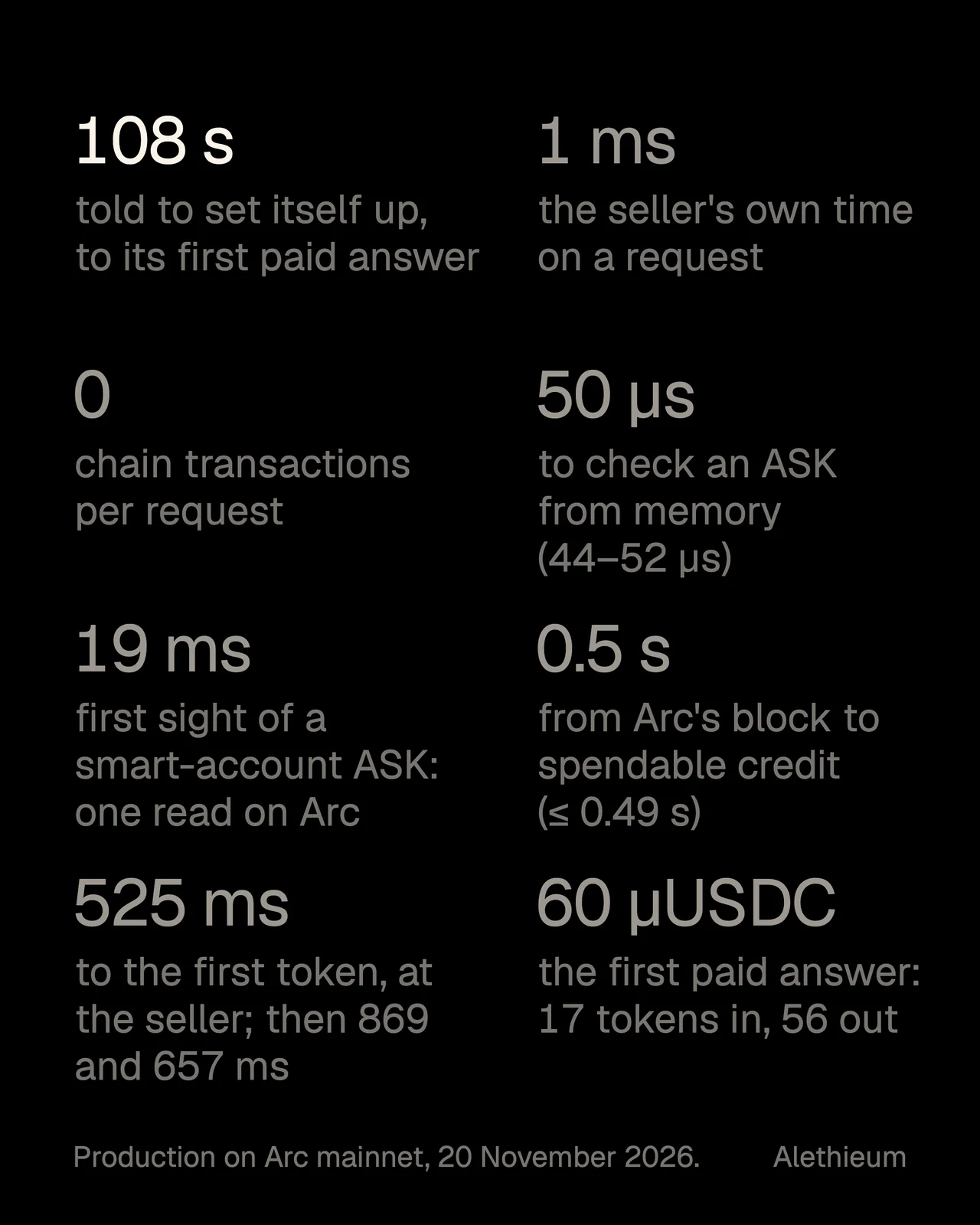
What follows is a market whose participants need no person to admit them.
References
- Visa Developer, Visa Intelligent Commerce: overview. Read 2026-11-21. https://developer.visa.com/capabilities/visa-intelligent-commerce/overview
- The Next Web, report on the launch of a chat assistant's wallet, November 2026. https://thenextweb.com/news/chatgpt-wallet-openai-dots-agents-payments
- Launch announcement of the best-known browser agent, 2025-01-23. https://openai.com/index/introducing-operator/
- The Next Web, report on Visa's Agentic Commerce Benchmark, 2026-11-05. https://thenextweb.com/news/visa-ai-shopping-benchmark-agentic-commerce-ai-models-fail
- "Broken Gates", arXiv 2607.18659, version 2, 2026-11-05. https://www.alphaxiv.org/abs/2607.18659
- Anchorage Daily News (syndicated from The Washington Post), a journalist's test of a browser agent, 2025-02-09. https://www.adn.com/alaska-life/2025/02/09/i-let-chatgpts-new-agent-manage-my-life-it-spent-31-on-a-dozen-eggs/
- RFC 6750: The OAuth 2.0 Authorization Framework: Bearer Token Usage. October 2012. https://www.rfc-editor.org/rfc/rfc6750
- GitHub, "The next evolution of GitHub Advanced Security", 2025-04-01. https://github.blog/security/application-security/next-evolution-github-advanced-security/
- GitGuardian, "The State of Secrets Sprawl 2026", 2026-03-17. https://blog.gitguardian.com/the-state-of-secrets-sprawl-2026/
- GitHub, "Secret protection must scale with software", 2026-10-07. https://github.blog/ai-and-ml/secret-protection-must-scale-with-software
- S. Willison, "The lethal trifecta for AI agents", 2025-06-16. https://simonwillison.net/2025/Jun/16/the-lethal-trifecta/
- OWASP, "Top 10 for Agentic Applications", 2025-12-09. https://genai.owasp.org/2025/12/09/owasp-top-10-for-agentic-applications-the-benchmark-for-agentic-security-in-the-age-of-autonomous-ai/
- EIP-191: Signed Data Standard. Final, created 2016-01-20. https://eips.ethereum.org/EIPS/eip-191
- ERC-1271: Standard Signature Validation Method for Contracts. Final, created 2018-07-25. https://eips.ethereum.org/EIPS/eip-1271
- ERC-6492: Signature Validation for Predeploy Contracts. Final, created 2023-02-10. https://eips.ethereum.org/EIPS/eip-6492
- EIP-4361: Sign-In with Ethereum. Final, created 2021-10-11. https://eips.ethereum.org/EIPS/eip-4361
- ERC-8004: Trustless Agents. Draft, created 2025-08-13. https://eips.ethereum.org/EIPS/eip-8004
- RFC 6979: Deterministic Usage of DSA and ECDSA. August 2013. https://www.rfc-editor.org/rfc/rfc6979
- EIP-712: Typed structured data hashing and signing. Final, created 2017-09-12. https://eips.ethereum.org/EIPS/eip-712
- Circle, "Circle launches Arc mainnet", 2026-09-16. https://www.circle.com/pressroom/circle-launches-arc-mainnet-an-economic-operating-system-for-the-internet
- Arc documentation, "Gas and fees". Read 2026-11-21. https://docs.arc.io/arc/references/gas-and-fees
- Arc documentation, "Deterministic finality". Read 2026-11-21. https://docs.arc.io/arc/concepts/deterministic-finality
- Circle documentation, Agent Wallets: quickstart. Read 2026-11-21. https://developers.circle.com/agent-stack/agent-wallets/quickstart
- An identity vendor's published design for agent registration, 2026-05-21. https://workos.com/blog/agent-registration-with-auth-md
- A reseller's guide to agent self-registration, 2026-05-01, updated 2026-10-08. https://bazaarlink.ai/en/blog/ai-agent-self-register-api-key-langchain-crewai-en
- A sign-in vendor's published pricing. Read 2026-11-21. https://auth0.com/pricing
- A messaging vendor's published pricing for verification codes. Read 2026-11-21. https://www.twilio.com/en-us/verify/pricing
- A card processor's published United States pricing: cards, fraud screening, billing, tax, disputes and identity checks. Read 2026-11-21. https://stripe.com/pricing
- The same card processor's documentation, minimum charge amounts. Read 2026-11-21. https://docs.stripe.com/currencies
- A public ERC-8004 registry explorer. Read 2026-11-21. https://8004scan.io/
- Ando Infer, pages for agents and API index. Read 2026-11-21. https://infer.andoai.xyz
Measurements marked as ours were taken in production on Arc mainnet on 20 November 2026, or in controlled benches between 8 and 20 November 2026, and come from the service's request ledger and from Arc. Figures attributed to others are their published claims or list prices, as cited. Disclosure: Circle's announcement of Arc mainnet names Alethieum among the builders in Arc's ecosystem [20].
Next
Specification · version 1 · CC0 1.0
The product it's about
Headless inference: the place where AI buys its own thinking.